What a “skylight installer” should actually mean
Search “skylight installers Ipswich” and you get a mix of results. Double-glazing firms with a rooflight page. General roofers who will fit a VELUX between tile jobs. National lead-generation sites with a Suffolk postcode dropped into a template. Most of them can put a rooflight in a roof. The question is whether they do it often enough to do it well, and whether the person quoting you knows why a job goes wrong before it does.
A general roofer might fit a dozen rooflights in a year, in between re-tiling, guttering and flat-roof recovers. That is not a criticism of roofers. It is a description of where their attention lives. Fitting a rooflight is a small part of a broad trade, so the detailing that decides whether it leaks in five years gets learned slowly, one callback at a time. The parts of the job you cannot see once the scaffold comes down are exactly the parts a specialist obsesses over and a generalist rushes.
We fit skylights and rooflights, and nothing else. Not windows, not doors, not fascias, not full roofs. That focus shows up in three places a homeowner can actually check.
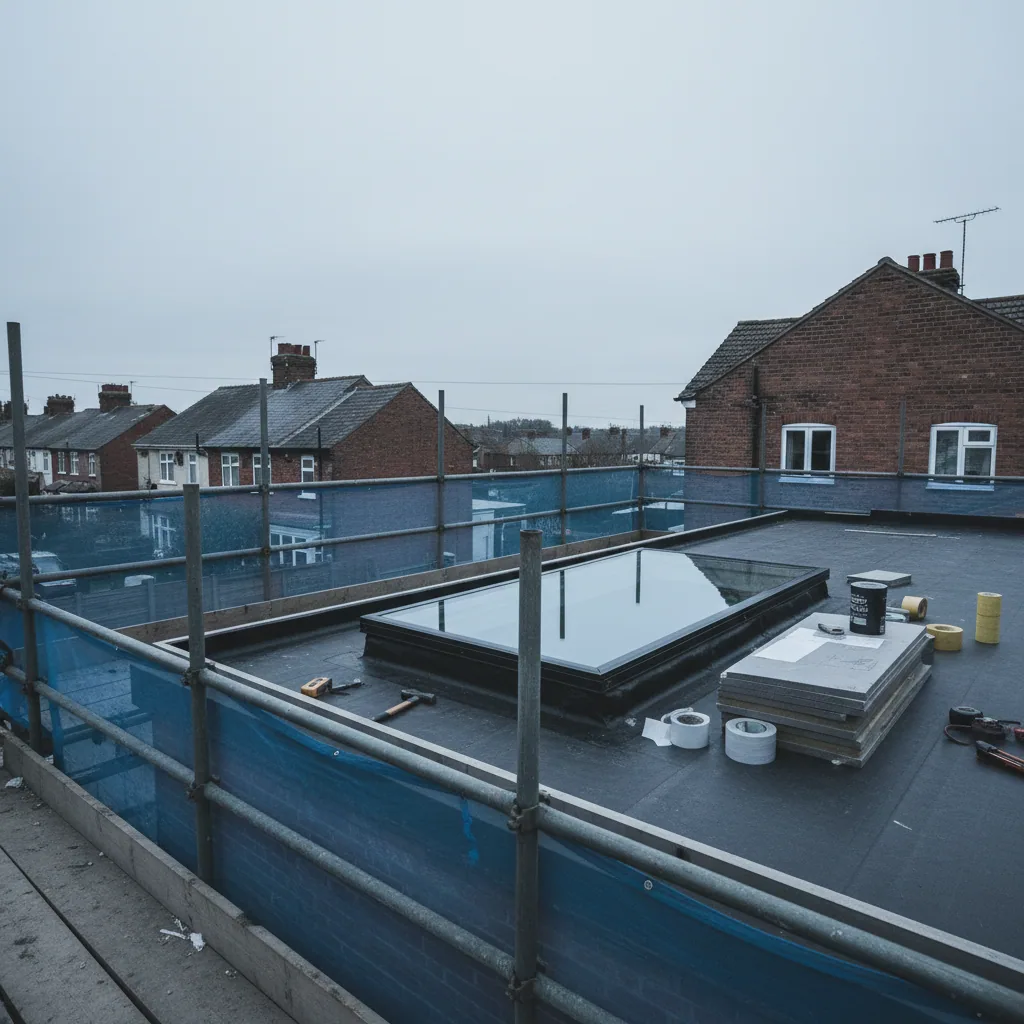
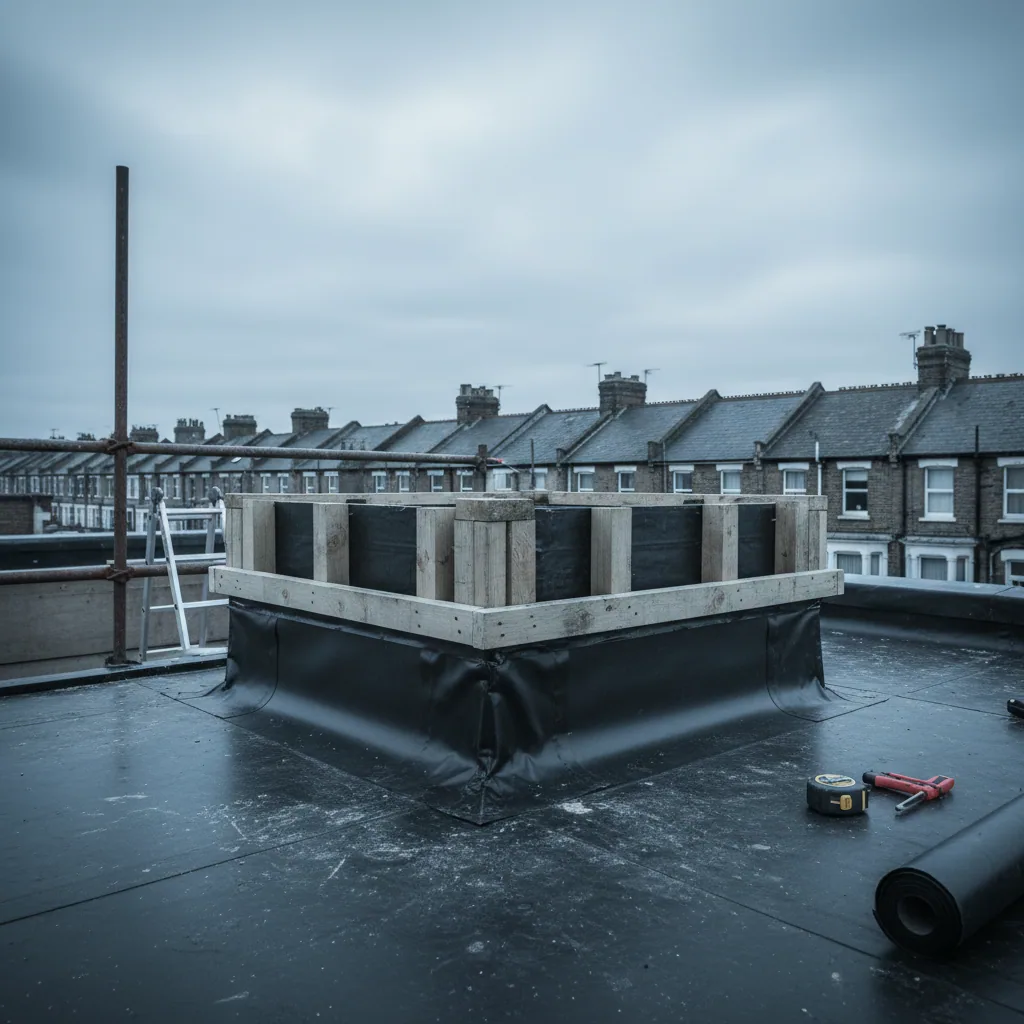
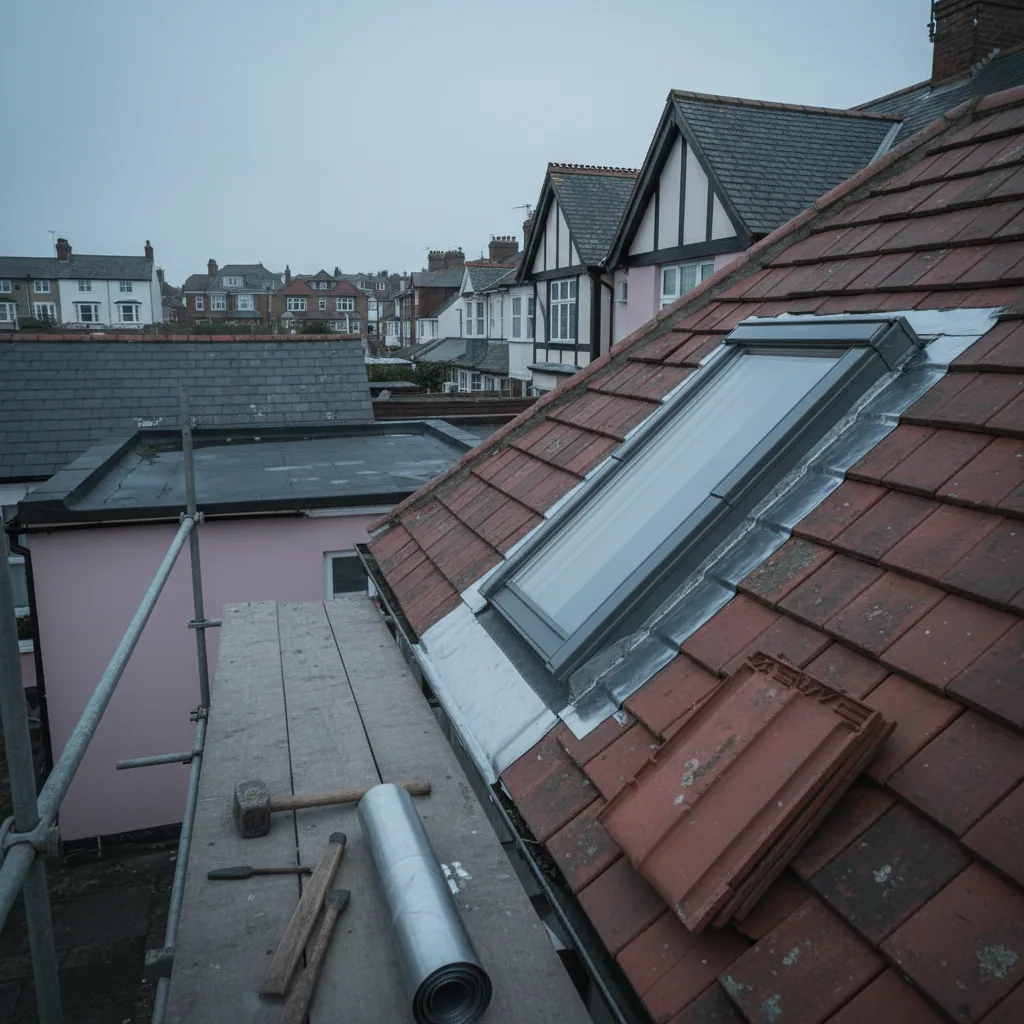
The first is the upstand and the flashing. Water does not get in through the glass. It gets in at the junction between the rooflight and the roof, where the kerb meets the covering and the flashing laps over it. A flat-roof rooflight needs an insulated upstand of the right height, usually 150mm above the finished roof surface, with the waterproofing dressed up and over it and the unit sitting proud so surface water runs away rather than pooling against the frame. A pitched-roof window needs its flashing kit laced into the tiles or slates correctly, with the right side soakers and a top apron that sheds water onto the covering below, not behind it. Get the height wrong, dress the membrane short, or reuse a flashing kit meant for a different tile profile, and the unit will leak. Not on day one. On the first night the wind drives rain uphill.
The second is the survey. A quote given over the phone, or off a photo, or by a salesperson who never went into the loft, is a guess. A proper survey looks at the roof structure, the rafter or joist spacing, the covering, the insulation line, the internal finish and the access. It confirms whether the opening you want needs a rafter cut and a trimmer, or whether the unit can sit between existing members. It is where the fixed quote comes from, and it is why our fixed quote holds: we have already found the things that turn into “extras” on other jobs.
The third is a specialist’s willingness to say no. Sometimes the rooflight a customer has set their heart on is the wrong unit for the roof, or the opening they want breaches a fire-escape rule on a loft conversion, or the pitch is too shallow for the model chosen. A firm that fits rooflights all week will tell you that before you have paid for it. A firm chasing the sale will fit it and let you find out later.
The single most useful question you can ask any installer: “How many rooflights did you fit last month?” A specialist has a number and a story. A generalist changes the subject to how long they have been “in roofing.” Roofing is not rooflights.
Why the east-coast setting changes the job
This is where most of what you read online stops being useful, because almost none of it is written for the Suffolk and north-Essex coast. A rooflight specified for a house in the Midlands is specified for a benign environment: still air, ordinary rain, no salt. Move that same specification to a roof within sight of the sea and it starts to fail years earlier than it should. The reason is airborne chloride.
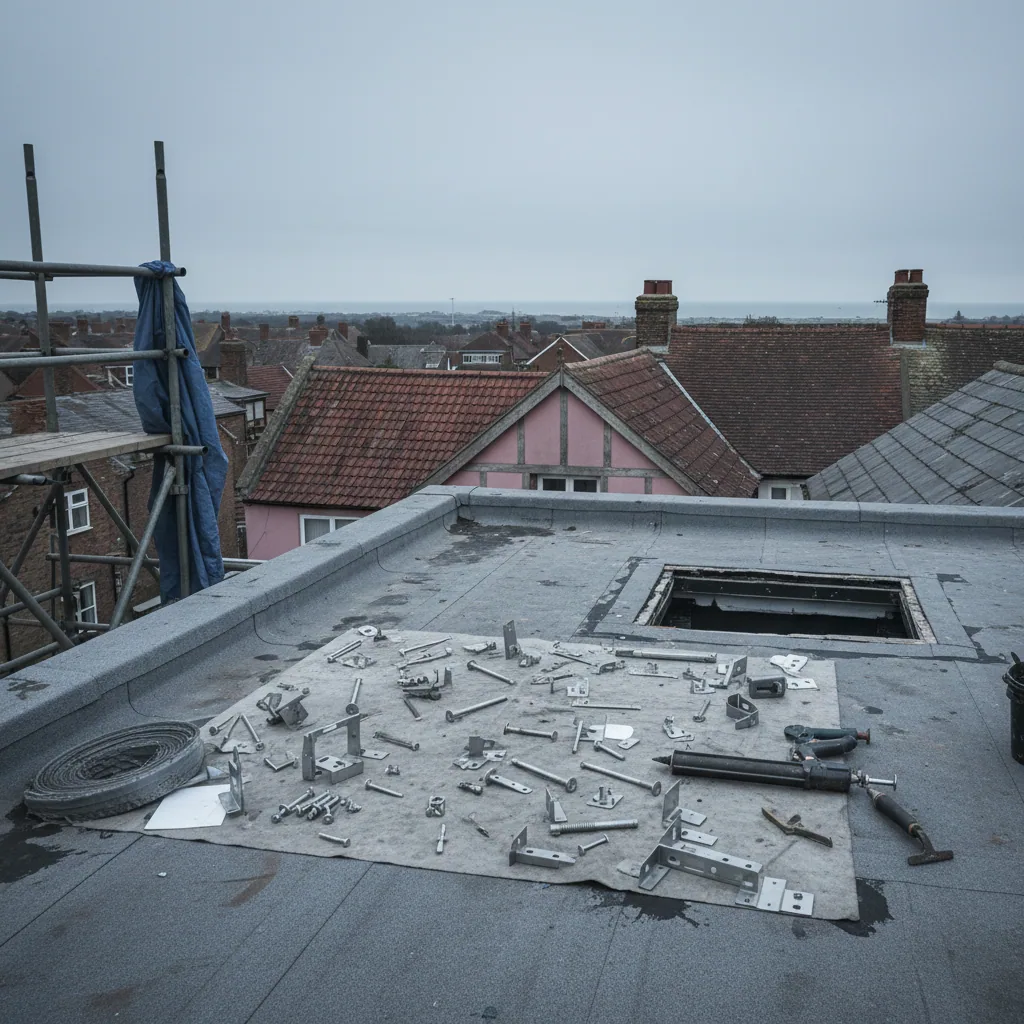
Salt does not stay in the water. Onshore wind picks up fine chloride-laden droplets and carries them inland, where they settle on every exposed surface and, crucially, into every joint and fixing. Chloride is what breaks down the passive oxide layer that protects stainless steel. A standard A2 grade stainless fixing, the sort used on most inland rooflight work, will begin to pit and stain in a marine atmosphere. Powder coating that is fine in Warwickshire chalks and fades faster on an exposed east-coast elevation. Aluminium that is not marine-treated develops white corrosion at the cut edges. None of this is dramatic on a single winter. Over ten and fifteen years it is the difference between a rooflight that is still weathertight and one that is weeping at the fixings.
For genuinely coastal work we specify differently. Marine-grade 316L stainless fixings, which carry molybdenum that resists chloride pitting far better than A2. Marine-specification coatings and seals rated for the exposure. Extra attention to the fixing detail, because on the coast the fixing is where corrosion starts and where wind load is highest. It costs a little more. On a roof that takes the full weight of a North Sea gale off Felixstowe or Harwich, it is the only sensible way to build.
What matters just as much is not overselling it. The exposure is not the same everywhere within our thirty-mile radius, and pretending it is would be dishonest. There are three bands, and they call for three different answers.
How exposure changes across our area, and what it changes
| Band |
Where |
What the roof actually gets |
What we change |
| Inland suburbs |
Kesgrave, Rushmere St Andrew, central Ipswich, Stowmarket |
Ordinary rain and wind, no meaningful salt loading |
Standard specification, correct upstands and falls. The job is about detailing, not corrosion. |
| Estuarine |
Woodbridge, Shotley, Pin Mill, Manningtree, Wivenhoe |
Tidal saline water and strong wind across open water, but moderate salt loading, not open sea |
Upgraded fixings are sensible. We treat these as a step up, not as full marine, because that is the honest reading. |
| Open coast |
Felixstowe, Harwich, Aldeburgh, Southwold, Clacton |
Full driven-rain and salt exposure, accelerated corrosion of standard fittings |
Marine-grade 316L fixings, marine-specification coatings, the full coastal build. |
The band is confirmed at survey by looking at aspect, distance from open water and how sheltered the specific elevation is. A north-facing Woodbridge roof behind other buildings is a milder job than a Felixstowe seafront elevation, and we price it that way.
Estuarine locations get the honest version. Woodbridge, Manningtree and the villages along the Orwell and Stour sit on tidal water with real wind exposure, so upgraded fixings are a fair call. They do not get open-sea salt loading, and we will not tell you they do to justify a bigger bill. That distinction is the whole point of a specialist who lives and works here rather than a national firm reading a postcode off a map. If you want to see exactly which band your address falls into, the areas we cover pages set it out town by town, and Felixstowe is the worked example of a full coastal build.
Matching the rooflight to the project
“Skylight” covers several quite different products, and the right one depends on the roof and the room, not on fashion. A short guide to the main choices, with the detail sitting on the service pages.
Flat roofs, extensions and roof lanterns
Most single-storey rear and side extensions have a flat or very low-pitched roof, and the two common daylight options are a flat rooflight sitting near-flush, or a roof lantern standing proud with pitched glazing. A flat glass rooflight gives a clean modern line and suits a contemporary kitchen-diner. It needs the right fall built into the roof so water clears it, and a well-made insulated kerb underneath. A roof lantern makes more of a feature, throws light deeper into the room because the glazing faces several directions, and gives that raised, characterful ceiling. The trade-off is cost and a taller structure to weather. Our flat roof skylight installation page walks through kerb construction, falls and the leak points that matter on this kind of roof.
Pitched roofs, lofts and roof windows
On a pitched roof, whether it is a loft conversion or a new window into an existing slope, the unit is a roof window that sits in the plane of the roof and is flashed into the covering. This is classic VELUX window installation territory, and VELUX, Keylite and Roto all make good units at this. We are experienced VELUX, Keylite and Roto installers, which lets us match the window and, more importantly, the flashing kit to your exact tile or slate profile rather than forcing a generic kit to fit. The pitched roof skylight installation page covers minimum pitches, flashing detail and how the units lace into different roof coverings.
Energy, glazing and orientation
Two numbers decide how a rooflight behaves once it is in. The U-value is how much heat escapes through it: lower is better, and current standards for a replacement unit ask for 2.2 W/m²K or better, though a good modern rooflight beats that comfortably. The g-value is how much of the sun’s heat comes through: lower means a cooler room in summer. The catch is that the right g-value depends on which way the roof faces. A north-facing rooflight over a shaded room wants a higher g-value to make the most of what light there is. A south or west-facing rooflight over a kitchen extension wants solar-control glazing with a lower g-value, or the room bakes in July. Getting this right at specification is far cheaper than fitting blinds to fix it afterwards. Our energy efficient skylight installation page goes into U-values, g-values and how the glazing choice interacts with the rest of the building. If you would rather start from a working example, the guides take specific rooms and projects one at a time.
The Suffolk property factor
The housing stock in our area is unusually varied, and the property decides how the rooflight goes in far more than the brochure does. The same VELUX behaves like a different job in a Victorian terrace, a timber-framed cottage and a new-build.
Victorian and Edwardian Ipswich terraces tend to have steep slate or clay-tile roofs and slim rafters at tight, irregular spacings. Fitting into them often means a rafter cut and a properly sized structural trimmer, and the flashing has to suit an older, sometimes uneven, covering. Suffolk timber-framed and pink-washed cottages, common through the villages, are a different animal again. The roof structure can be hand-cut, irregular and load-sensitive, so you cannot just cut through a member and hope. These roofs need the opening designed around the frame, not forced through it. 1960s to 1980s estate houses around the town are usually trussed roofs, where cutting a truss without an engineered replacement is genuinely dangerous, so the opening is planned to sit between trusses wherever possible. New-build growth at Kesgrave, Martlesham, Grange Farm, Ravenswood and Sproughton means modern trussed roofs with predictable spacings and clean coverings, which is the most straightforward rooflight job of the lot, provided the fitter respects the truss design.
Then there is the conservation dimension, which Suffolk has in abundance. Central Ipswich, Lavenham, Aldeburgh, Dedham, Southwold and a long list of villages sit within conservation areas or contain listed buildings. On these properties a standard modern rooflight can be refused, and the answer is usually a conservation rooflight: a slim, flush-fitting unit with a central glazing bar and a low-profile frame that reads like a traditional cast-iron rooflight from the ground. These often need consent as well as the right unit, and getting either wrong is expensive. This is a genuine gap in what local firms cover, and it is one we take seriously.
Building Regulations and planning, plainly
Most rooflight work is simpler on the planning side than people fear, and stricter on the Building Regulations side than they expect. Here is the honest version.
Planning permission. For most houses, fitting a rooflight falls under permitted development, so you do not need planning permission, provided the rooflight projects no more than 150mm above the plane of the roof slope and does not sit above the highest part of the roof. That covers the large majority of loft and extension rooflights. The exceptions matter: conservation areas, listed buildings, and properties under an Article 4 direction that has removed permitted development rights. On a listed building you will likely need listed building consent regardless of size, and in a conservation area you may need planning permission and a conservation-style unit. If you are in one of these areas, check before you order, not after.
Building Regulations. These apply whether or not you need planning permission, and they are where the technical standards live. Part L sets the thermal performance: a replacement rooflight in an existing home must hit a U-value of 2.2 W/m²K or better, and new-build work is tighter still, set by the whole-dwelling calculation. Part B covers fire, and it bites hardest on loft conversions, where an escape window of a minimum openable size and reachable height is a legal requirement, not an option. A rooflight in a converted loft is often doing double duty as the fire escape, which is exactly the sort of thing a specialist checks and a rushed fitter misses. Part K covers guarding where there is a fall risk.
One point we put in writing because other firms go quiet on it: where a replacement is notifiable, we handle the Building Control notification for you. It goes to the local authority as a building notice, an independent Building Control officer inspects the work, and you get a compliant completion certificate at the end. We tell you at survey which route your job needs and deal with the paperwork so you do not have to. The rules on all of this are covered in more depth across the guides.
Why we replace, and do not patch
When a rooflight fails, the trade default is to reseal it. New bead of sealant, maybe a new gasket, and it stops dripping for a while. We do not offer that, and it is worth explaining why rather than just asserting it.
A failed rooflight rarely fails for one isolated reason. Sealant does not perish on its own: it perishes because the unit has been flexing, or the fixings have moved, or the frame has taken up water, or the glazing seal has gone and the misting you can see is the visible half of a problem the resealer cannot reach. Reseal the outside and you have treated the symptom while the cause carries on. The patch buys a season, sometimes a year, and then you are back where you started, having paid twice and lost the roof to a second disruption.
The whole-life cost is what settles it. A patch that has to be redone every year or two, each time with access and disruption, costs more across five years than a single correct replacement that then runs for fifteen with a guarantee behind it. And a rooflight that has genuinely failed is usually telling you something about its neighbours. If one 18-year-old unit has gone, the others fitted at the same time, in the same weather, with the same seals, are near the end of their life too. Replacing the failed one and nervously watching the rest is a slower version of the same expense. The costs page sets out replacement figures openly, including the case for doing several at once, so you can see the arithmetic rather than take our word for it.
What you are actually buying
Set aside the daylight and the finished photographs for a moment, because those are the easy part. What you are really buying from a skylight installer is a hole cut in your roof that stays watertight for years, on a coast that tests it hard. Here is what stands behind that with us.
A fixed quote after a proper survey. The price you are given is the price you pay, because the survey has already found the things that become “extras” elsewhere. No mid-job discoveries, no phone call halfway through asking for more.
Twenty-five years in the trade. That is installer experience, hands on roofs, not a company age. The business is new and we say so; the people fitting your rooflight are not.
A 10-year workmanship guarantee on every installation, in addition to whatever product warranty the unit itself carries. If our work lets water in, we come back and put it right.
A commitment that your roof is never left open overnight. We plan the work so the roof is opened and made weathertight within the same working day. Cutting into a roof and leaving it under a tarpaulin overnight is where a lot of the leak fear comes from, and it is avoidable with sensible sequencing.
And trust you can actually check. It is carried by the process, the technical detail and the guarantee: a survey on the roof, a fixed written price, the flashing detail photographed before the trims go on, and a 10-year workmanship guarantee behind every installation. That is the kind of trust that survives contact with a hard winter. If your project is a workplace rather than a home, the commercial skylight installation hub handles that side, and the full range sits on the services page.
Where to start
If you are planning an extension or a loft conversion, or you have a rooflight that has started to leak, mist or draught, the useful next step is a survey and a fixed quote. Tell us the property, the roof and what you are trying to do, and we will tell you plainly what suits it, which exposure band you are in, and what it will cost. Start on the get a quote page and we will take it from there.