Skylight Installation in Felixstowe
- Fixed quote before we start
- Roof never left open overnight
- 10-year workmanship guarantee

- Fixed quote before we start
- 10 years workmanship guarantee
- 25 years fitting rooflights
- Skylights only, not a general roofer
Felixstowe is about 10.7 miles from Ipswich in a straight line, which in practice is twenty-five to thirty minutes on the A14. The drive is easy. The roofs are not. This is full open North Sea exposure, nothing between the seafront and the water, and the airborne chloride that comes with it changes what a rooflight installation has to be made of.
Most of the failures we are called out to look at in Felixstowe are not failures of glass, and they are rarely failures of the weathering detail either. They start at the fixings.

Why A2 stainless does not survive on a Felixstowe roof
Nearly every rooflight sold in this country arrives with A2 stainless fixings, and inland that is a sensible default. A2 is 304-grade austenitic stainless and on a house in Stowmarket it will outlive the person who fitted it.
Chloride is what breaks it. Salt-laden air deposits chloride ions on the metal, and where they concentrate they break down the thin passive chromium oxide film that makes stainless stainless. Once that film is punctured in a spot, corrosion drives downward into the pit rather than spreading across the surface. That is why chloride pitting is so easy to miss. The screw head looks tolerable from the ground while the shank is being eaten out of sight.
316L is the answer, and the reason is molybdenum. Two to three per cent of it in the alloy, doing one job: stabilising the passive film against chloride attack. The L means low carbon, which keeps the grain boundaries from sensitising. In coastal specification 316L is not an upgrade, it is the baseline. On every job we do in Felixstowe the frame fixings, kerb straps and flashing screws are 316L as standard, priced in rather than added on.
What to look for on an existing unit: rust-coloured tear streaks running down from a screw head, or a chalky white bloom around the fixing points. Both mean the fixing is corroding under the surface. The bloom in particular is the aluminium around the fastener reacting, and by the time you can see it the metal underneath has already lost section.
Bimetallic contact at the flashing, the failure nobody plans for
The second problem is subtler and it does more damage. Put two dissimilar metals in contact, add an electrolyte, and you have a battery. Salt-laden moisture on a Felixstowe roof is an extremely good electrolyte. The less noble metal becomes the anode and corrodes preferentially, and it does so far faster than either metal would corrode on its own.
On a rooflight this happens in a handful of predictable places. An aluminium flashing apron fixed with a steel or plated screw. A lead soaker dressed against an aluminium kerb. A stainless fastener bearing directly on bare aluminium sheet. In each case aluminium is the sacrificial partner, and the corrosion concentrates exactly where the water sits and the movement happens, which is the joint you least want opening up.
The fixes are dull and they work. Match the fixing metal to the sheet where you can. Where you cannot, isolate the contact with a nylon or EPDM washer so the two metals never touch. Keep lead away from aluminium entirely rather than trusting a coating to separate them. Detail the joint so water drains off instead of standing, because the corrosion cell only runs while the electrolyte is present. None of this costs much. It is simply not what a standard inland detail assumes.
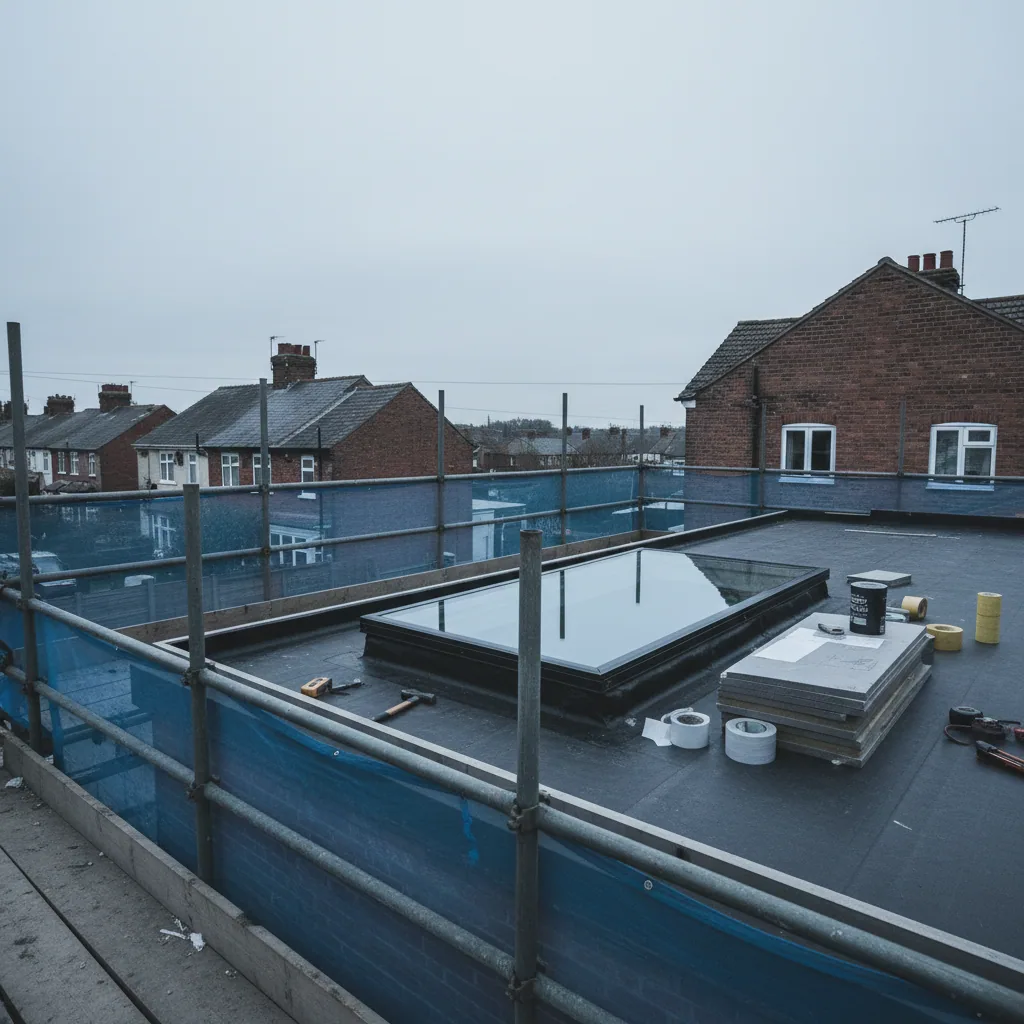
Tall terraces, access and the chimney stack problem
The seafront stock here is largely big Edwardian and Victorian terraces, three storeys and often more with the roof volume above that. Behind them, post-war estates on a more ordinary scale. The terraces are the interesting job.
Height drives cost before anything else does. A rooflight in a third-floor slope needs a proper scaffold with a working lift at the eaves, and on a terrace with no side access that scaffold is coming through the house or off the pavement with a licence. Better said at survey than discovered on the Monday. It is a real number and it goes in the fixed quote.
Chimney stacks are the other constraint. These terraces have tall stacks, often shared on the party wall, and a stack sheds water and sits in its own zone of turbulence. Too close to one and the flashing has to compete with the stack’s own lead work, with driven rain rolling off it onto the head of the unit. We keep clear distance where the room layout allows, and where it does not the head detail gets built up. A pitched roof skylight installation in a slate terrace is careful work, and slate forgives nothing approximate.
Rear extensions on this stock tend to be flat or near-flat, which puts them into flat roof rooflight or roof lantern territory. Lanterns near the seafront want a marine-specification coating on the aluminium as well as the 316L fixings, and both together, not one or the other. For glazing performance in a room facing that much sky, energy efficient rooflight specification is worth the conversation.
Felixstowe stock, from the cliff gardens to the Ferry
Felixstowe grew as an Edwardian resort, and the seafront still carries that stamp: tall rendered and gault-brick terraces, three and four storeys, with steep slate or plain-tile roofs and the deep roof volumes that came with attic bedrooms and servants’ floors. Behind the front, the town flattens into interwar and post-war semis on more ordinary roofs, and out towards the Ferry and the golf links the stock thins to detached houses and bungalows facing the mouth of the Deben. Each band sits in a slightly different exposure, and the specification should track that rather than treating the whole town as one site.
The seafront terraces are the hardest jobs and the most rewarding. Their height puts the roof squarely in the wind coming off the water, their slate demands careful stripping and relaying around any opening, and their deep plans mean a rooflight is often the only way to get daylight into a middle floor the original builders left dark. Roof volumes that generous convert well, which is why a good share of our Felixstowe work is loft rooms rather than extensions.
Chloride does not stop at the front
People a few streets back from the seafront often assume the salt is somebody else’s problem. It is not. Airborne chloride is carried inland on the prevailing wind and deposited across the whole town, at a concentration that falls with distance but does not reach zero anywhere in Felixstowe. A roof half a mile from the beach still collects enough to pit A2 stainless over time, particularly in sheltered pockets where salt lands but rain does not rinse it off. That is why we specify marine grade throughout the town rather than drawing a line near the promenade and pretending the streets behind it are inland.
What changes with distance is not whether to upgrade but how hard the components are working. On the front, corrosion is fast and visible, and the coating and fixings are both under constant load. Set back, the same failures run more slowly, which lulls people into fitting an inland unit that then fails at an age when it should have years left. The honest reading of a Felixstowe roof looks at aspect, at whether anything upwind provides genuine shelter, and at how well the slope drains and rinses, then sets the specification to that.
Old Felixstowe and the roads above the cliff gardens are worth a separate word. The stock there runs to larger detached houses and interwar villas on more generous plots, often with hipped tile roofs and, increasingly, flat-roofed rear extensions built to open a kitchen onto the garden. Those extensions are prime lantern and flat-rooflight territory, and because they sit high with a clear line to the water, the coating and fixing specification is the full marine package rather than a judgement call. The falls on a new flat roof matter as much as the glazing here, because a lantern dropped into the natural low point of a deck collects the water that then gets driven against its kerb in an easterly. We set the unit clear of the low spot and check the deck drains around it, which is a detail an inland fitter can be casual about and a seafront one cannot. The same care goes into the kerb height, because a lantern lifted properly clear of the deck keeps its glazing edge out of the water that driven rain pushes across a flat roof here.
Working in Felixstowe
Skylight installation in Felixstowe is replacement work as often as it is new openings, because a coastal unit fitted to inland specification reaches the end of its life years before the manufacturer literature suggests it should. We do not patch or reseal failing units. Patching a corroded fixing line buys a season and costs you the season after it.
Every job is surveyed on the roof and priced once in writing, installed to current Building Regulations, with a 10-year workmanship guarantee. Twenty-five years in the trade between the installers, and experienced with VELUX, Keylite and Roto units.
We cover the same coast at Trimley St Mary and Shotley Gate, and inland up the river at Woodbridge. The full list is on areas we cover.
Request a fixed quote. If you send a photograph of the existing unit taken from inside, we can usually tell from the fixing heads how much life is left in it.
Are 316L fixings really necessary in Felixstowe, or is that an upsell?
Necessary. The airborne chloride load here is high year round, not just in a storm. A2 stainless pits under chloride attack, and pitting works downwards into the metal rather than across it, so a fixing can lose most of its section while the visible head still looks acceptable. 316L carries molybdenum, which stabilises the passive film against exactly that. We fit it as standard and price it in.
My rooflight has white powdery marks around the screws. What is that?
Aluminium corrosion product, and it usually means a bimetallic cell has set up between the fixing and the sheet it passes through. Salt-laden moisture completes the circuit and the aluminium corrodes as the anode. It will not stop on its own. Once the metal around the fixings has lost section the unit needs replacing rather than resealing, because the fastener has nothing sound left to clamp against.
Can you scaffold a three-storey seafront terrace with no side access?
Yes, though it usually means a pavement licence and a scaffold erected from the front or through the property. That carries a cost and a lead time, and both go into the fixed quote after survey rather than appearing later. We check the access route first, because on tall stock it can be a meaningful share of the total price.
Does being near the port change the specification?
The port is not the issue. The exposure is. Felixstowe faces open water with no landmass shielding it, so driven rain arrives with force behind it and the air carries salt well beyond the seafront streets. Properties a mile back still get chloride deposition, so we specify marine grade throughout the town rather than drawing an arbitrary line near the beach.
Does the container port affect the roofs in Felixstowe?
Not directly. The port sits at the south end of the town and does not change the corrosion picture. What drives the specification is the open-water exposure: Felixstowe faces the North Sea and the mouths of two estuaries with nothing to shield it, so driven rain arrives with force and the air carries salt across the whole town. We specify marine-grade fixings and coatings on that basis, not on proximity to the docks.
Thinking about this job? We survey across Ipswich, Suffolk and north Essex and give you a fixed price before any work starts, with a 10-year workmanship guarantee.