Plastic & Polycarbonate Skylight Installation
- Fixed quote before we start
- Roof never left open overnight
- 10-year workmanship guarantee

- Fixed quote before we start
- 10 years workmanship guarantee
- 25 years fitting rooflights
- Skylights only, not a general roofer
Plastic rooflights have a reputation problem, and about half of it is deserved.
The deserved half comes from acrylic domes fitted across Suffolk in the 1980s and 1990s that are now yellow, crazed and brittle enough to put a boot through. The undeserved half is the assumption that follows: that polycarbonate is never the right answer. It frequently is. Over a detached garage, a workshop or a 12m industrial span, a multiwall polycarbonate rooflight beats glass on cost, weight and impact resistance, and nobody standing in a garage in November is grading the optical clarity.
Polycarbonate skylight installation in Ipswich splits into two conversations. One is “this is the right product for this building” and we get on with it. The other is “you have been quoted polycarbonate for a kitchen extension” and we will spend ten minutes talking you out of it, because in a habitable room it is a decision people regret inside three years.
Where polycarbonate genuinely makes sense
These are the cases where we fit plastic without hesitation, and where recommending glass would be selling you something you do not need.
Outbuildings, garages and workshops
The requirement here is daylight and weather resistance, not appearance or thermal performance. The building is unheated, so a U-value of 1.8 W/m²K against 2.6 buys you nothing, and nobody is looking up at it. A multiwall polycarbonate unit costs roughly a third of an equivalent glass rooflight and does exactly what is asked of it for 20 years or more.
Garden rooms and studios, with a caveat
Unheated garden storage, potting sheds and workshop studios are fine. A garden room you intend to sit in, work in or heat is a habitable room in everything but the planning definition, and it should get glass. The tell is whether you will be in there in January.
Budget-constrained replacements
Sometimes the money is not there. A degraded dome over an unheated utility, a garage roof coming down in five years when the extension goes ahead, a rental property where the requirement is watertight and functional. Polycarbonate does that job at a fraction of the cost, and pretending otherwise helps nobody.
Large industrial and commercial spans
Here polycarbonate is not a compromise at all. It is the correct engineering answer. Barrel-vault rooflights running 15m or 20m along an industrial roof, in-plane sheets bedded into profiled metal, factory and warehouse daylighting. Glass at that scale is prohibitively heavy. Polycarbonate weighs roughly a sixth of glass for equivalent coverage, spans further between purlins, and can be specified as non-fragile to ACR[M]001 so a maintenance operative who steps on it does not go through. That work is covered on our commercial skylight installation page.
Anywhere impact is a real risk
Polycarbonate is around 200 times more impact resistant than glass of the same thickness. Under a tree that drops branches, on a building where footballs land, that property is worth more than clarity.
The short test. Will anyone spend real time in the room, looking up, with the heating on? If yes, fit glass. If no, polycarbonate is very likely the sensible buy and we will quote it without trying to upgrade you.
The materials, and what the words on the quote mean
Three different plastics get sold as the same thing, and they behave differently.
Polycarbonate is the good one. Very high impact resistance, good heat tolerance, available as solid sheet or multiwall. Untreated it degrades badly in ultraviolet light, so every rooflight-grade sheet carries a co-extruded UV-protective layer on the weather face. That layer is the whole product. A sheet fitted upside down, UV face inward, yellows in about five years instead of twenty, and that mistake is more common than it should be.
Acrylic, sold as PMMA or under trade names, has better optical clarity and holds its colour longer, but it is brittle and cracks rather than flexes. Almost every 1980s and 1990s dome across Suffolk is acrylic, which is why the failure people remember is crazing rather than yellowing.
GRP, glass reinforced plastic, appears on older industrial roofs as translucent in-plane sheets. It chalks and erodes as the resin weathers away from the glass fibre, and it sits behind most fragile-rooflight fall incidents in the UK.
Multiwall structures and U-values
Multiwall polycarbonate is two or more skins separated by internal ribs, and the trapped air in those cells does the insulating. More skins means more cells, a lower U-value, and less clarity. That is the trade, expressed in a single number.
| Structure | Typical thickness | U-value (W/m²K) | Light transmission | Clarity | Typical use |
|---|---|---|---|---|---|
| Twinwall | 10mm | 3.0 to 3.2 | 78 to 82% | Translucent, shapes visible | Carports, canopies, low-cost cover |
| Triple-wall | 16mm | 2.3 to 2.5 | 68 to 74% | Diffuse, outlines only | Garages, workshops, outbuildings |
| Five-wall | 25mm | 1.5 to 1.7 | 60 to 66% | Diffuse, no view out | Better-insulated outbuildings |
| Seven-wall | 32mm | 1.2 to 1.4 | 50 to 58% | Opaque glow | Industrial roofs where heat loss matters |
| Solid polycarbonate sheet | 6mm | 5.2 to 5.6 | 86 to 88% | Near clear | Impact zones, secure glazing, vandal-prone sites |
| Glass, double, argon, warm-edge | 24mm unit | 1.2 to 1.5 | 75 to 80% | Clear, full view of sky | Habitable rooms, anything you look up at |
Whole-unit figures vary with frame and cell geometry. Part L requires replacement rooflights in existing dwellings to reach 2.2 W/m²K or better, which rules out twinwall and triple-wall in a habitable room.
Read that table honestly and the central problem shows up immediately. To get polycarbonate to a U-value that satisfies Part L in a dwelling you need 32mm seven-wall, and at that point light transmission is around half and you cannot see anything through it. You have bought a glowing panel, not a rooflight. A double-glazed glass unit beats it on U-value with full clarity, at more money.

Dome rooflights and where they still belong
The dome is the shape most people picture when they hear plastic rooflight: a moulded acrylic or polycarbonate dome, single or double skin, sitting on a kerb over a flat roof. The shape is not accidental. A curved dome sheds water and debris without needing a fall built into the roof, self-cleans better than a flat panel because nothing sits on it, and is remarkably tolerant of a slightly out-of-true kerb.
Domes still make sense on garage and outbuilding roofs, utility areas, and stairwells in older housing stock where the existing kerb is sized for one and replacing like for like avoids structural work. They no longer make sense anywhere visible from a habitable room, or anywhere the appearance from outside registers. A dome reads as dated from the garden in a way flat glazing does not.
Modern domes are better than the ones being replaced: double-skin polycarbonate rather than single-skin acrylic, proper UV layers, better kerb detailing. One fitted today should give 20 to 25 years.

Polycarbonate against glass, without the sales pitch
The comparison as we would give it at survey.
| Polycarbonate | Acrylic | Glass | |
|---|---|---|---|
| Clarity | Diffuse in multiwall, near clear in solid sheet | Good optical clarity when new | Fully clear, you see actual sky |
| Realistic service life | 20 to 25 years | 20 to 30 years, poor for the last third | 25 to 35 years, minimal visual change |
| Yellowing | Slow with intact UV layer, rapid without | Noticeable from 12 to 15 years | None |
| Noise in heavy rain | Loud, drumming on thin sheet | Loud and higher pitched | Quiet |
| Impact resistance | Very high, roughly 200x glass | Low, cracks and shatters with age | Toughened outer, laminated inner, safe failure |
| Weight | Very light, roughly one sixth of glass | Light | Heavy, drives the structural design |
| Best U-value in practice | 1.2 with 32mm seven-wall, at 50% light | 2.8 to 3.4 double-skin dome | 1.2 to 1.4 double, 0.9 triple, full clarity |
| Thermal movement | High, needs oversized fixing holes | High | Low and predictable |
| Cost against glass | One third to one half | Roughly one third | Baseline |
The noise line in that table understates it. Suffolk gets around 600mm of rain a year, much of it wind driven off the North Sea at Felixstowe and along the coast, arriving against the vertical face of a dome as well as on top of it. In a garage that is irrelevant. Over a bedroom it is the complaint we hear most.
The yellowing timeline
Ultraviolet light breaks the polymer chains at the surface. The co-extruded UV layer absorbs that energy and sacrifices itself slowly, which is why the layer, not the sheet, sets the lifespan.
- Years 0 to 10: No visible change on a properly specified sheet, UV face outward.
- Years 10 to 15: A faint warm cast, generally only noticeable against a new sheet.
- Years 15 to 20: Clear yellowing, light transmission down 10 to 20 per cent, fine surface crazing on acrylic.
- Years 20 to 30: Heavy discolouration, chalking, and the crucial change: embrittlement. The sheet no longer flexes. It cracks.
That last point is a safety issue, not a cosmetic one. A 25-year-old acrylic dome will not take the weight of a person and it fails without warning. Treat any plastic rooflight of that age as fragile and do not step near it. This is the risk ACR[M]001 non-fragility testing exists to address on commercial roofs.


When polycarbonate is the wrong choice
We would rather lose the sale than fit plastic in a room where it will disappoint you.
Habitable rooms
Bedrooms, living rooms, home offices, anywhere with the heating on and people in it. Part L requires replacement rooflights in existing dwellings to achieve 2.2 W/m²K or better, and only the thickest multiwall sheets get there. Those sheets are opaque, so you have paid for a rooflight and received a light panel. Loft conversions in particular should get glass roof windows, covered on VELUX window installation and pitched roof skylight installation.
Kitchen extensions
The worst application of the lot. A kitchen rooflight is the feature of the room, looked at constantly, over the space where a family spends most of its time, and rained on hard several times a month. Polycarbonate fails on clarity, noise, appearance from the garden and thermal performance at the same time. Glass, whether a flat unit or a lantern, is the answer every time. See flat roof skylight installation and roof lantern installation.
Anywhere appearance matters
Visible from the street or the garden, in a conservation area, on a listed building. Conservation officers across Ipswich Borough, Babergh, Mid Suffolk and East Suffolk will not accept a plastic dome on a sensitive elevation, and they are right not to.
Where the view or the warmth is the point
If somebody said the words “we wanted to see the sky”, multiwall polycarbonate will not deliver it. Even triple-wall reduces the sky to a bright blur. That is not a defect, it is what a diffusing material does, but it needs saying before the order rather than after the installation. And if the goal is a warmer room or a better SAP figure, plastic works against you. Energy efficient skylight installation goes into the numbers.
The conversation we have most often. Somebody has been quoted polycarbonate for a kitchen extension because it came in £1,400 cheaper. Within three years they are replacing it, which means a second scaffold, a second strip and a second making good. The cheaper unit has cost more than the glass one would have.
Replacing a degraded dome
Most of our plastic rooflight work is not new installation. It is taking off a dome fitted in 1994 and putting something modern on the kerb. Three routes, and the right one depends on the room underneath.
- Like-for-like polycarbonate dome. Cheapest and quickest, uses the existing kerb if sound. Right for garages, utilities and outbuildings.
- Modern multiwall flat unit. Better insulated and less dated, still plastic. A middle route where budget is tight but the dome shape is the objection.
- Glass flat rooflight on a rebuilt kerb. The right answer wherever the space below is habitable. Costs more, ends the conversation for 30 years.
The kerb decides the price, not the unit. Domes from the 1980s and 1990s were commonly set on bare uninsulated timber kerbs 75mm to 100mm high rather than the 150mm we build to now. Two things follow. The uninsulated kerb cold-bridges right around the perimeter, showing up in January as condensation on the plasterboard reveal that people reasonably assume is a leak. And thirty years of water sitting against a low timber kerb means the timber is frequently soft by the time the dome comes off.
We inspect the kerb once the old unit is lifted, photograph what we find and show you. Where it is sound we rebuild the covering detail and set the new unit on it. Where it is not, we rebuild it insulated and continuous with the roof insulation, minimum 150mm above the finished roof at the lowest point of the fall. That is the intervention that ends the problem. We do not offer resealing or patching on any rooflight: a patch on a thirty-year-old dome and a wet kerb buys a season and touches none of the causes.

How we fit it
Plastic rooflights are lighter and simpler than glass, but the details that make them last are different rather than fewer. Thermal movement is the main one. A 2m polycarbonate sheet moves several millimetres between a January night and a July afternoon, and a sheet fixed rigidly crazes around the fixings within a few years.
- Survey and fixed quote. We measure the opening or existing kerb, check the structure and the fall, assess exposure and confirm what the room below is used for, which is the question that decides plastic or glass.
- Order. Stock domes and standard multiwall units are 1 to 3 weeks, made-to-measure 4 to 6. Nothing comes off the roof until the replacement is on site.
- Access. Tower or scaffold with edge protection, usually up the working day before. Old plastic rooflights are treated as fragile from the moment we arrive.
- Strip and inspect. Old unit lifted, kerb exposed, any decay photographed and shown to you before we proceed.
- Kerb. Built or rebuilt as an insulated box, minimum 150mm above finished roof at the lowest point, 200mm on exposed coastal sites, insulation continuous with the roof.
- Weathering in. Covering dressed up the full kerb height and over the top edge, laps mechanically terminated rather than adhesive only. The roof is watertight at the end of this stage, with or without the rooflight on it.
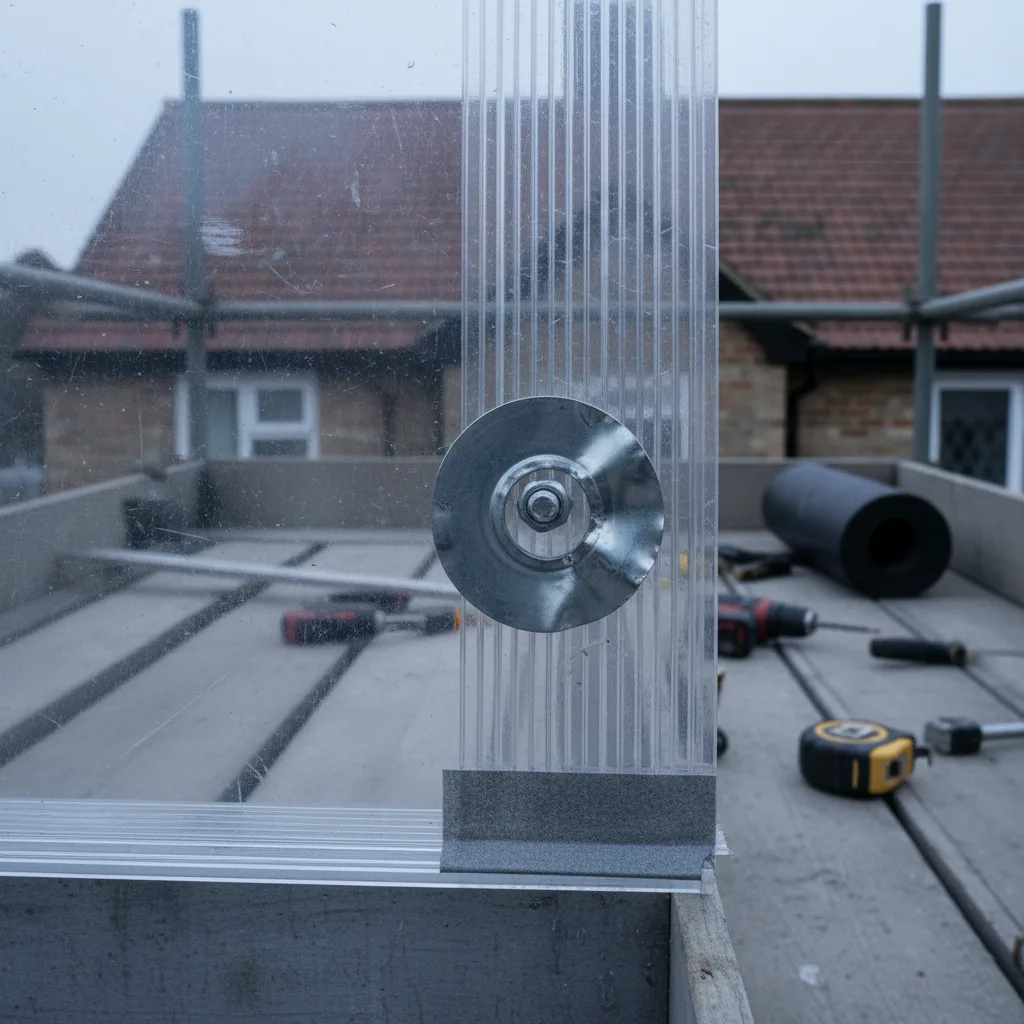
- Unit set with movement allowance. Oversized fixing holes, correct washers, no over-tightening. Multiwall cell ends get solid breather tape at the top and vented anti-dust tape at the bottom so condensation drains out instead of collecting. Cells full of water are the second most common complaint after noise, and they are entirely a fitting failure.
- UV face outward. Checked and confirmed. This sounds trivial. It is the difference between five years and twenty.
- Water test and handover. Hose test, a walk round the detail rather than the finish, guarantee documentation in writing.
Like-for-like dome replacement on a sound kerb is a one-day job. With a kerb rebuild it is two. Coastal work at Felixstowe, Harwich or Aldeburgh gets 316L stainless fixings and marine-specification detailing throughout, because chloride from salt-laden air stains grade 304 fixings down a frame inside two or three winters. Estuarine locations including Woodbridge and Manningtree carry moderate salt loading rather than open-sea exposure, so we specify upgraded fixings without charging for full marine treatment that is not needed.
What polycarbonate and dome rooflights cost
Supply and fit, single-storey with reasonable access, sound structure, across Ipswich, Suffolk and north Essex.
| Job | Typical supply and fit | Days on site | Guarantee |
|---|---|---|---|
| Dome replacement, existing kerb sound, up to 900 x 600mm | £620 to £950 | 1 | 10 years workmanship |
| Dome replacement, existing kerb sound, up to 1,200 x 1,200mm | £850 to £1,350 | 1 | 10 years workmanship |
| Dome replacement with full kerb rebuild | £1,400 to £2,300 | 1 to 2 | 10 years workmanship |
| New triple-wall polycarbonate unit, up to 1,500 x 1,000mm | £1,100 to £1,800 | 1 to 2 | 10 years workmanship |
| New five-wall or seven-wall unit, up to 2,000 x 1,000mm | £1,700 to £2,900 | 2 | 10 years workmanship |
| Multiwall in-plane sheets, outbuilding roof, per m² | £90 to £160 per m² | 1 to 2 | 10 years workmanship |
| Upgrade: dome out, glass flat rooflight in, up to 1,200 x 1,200mm | £2,100 to £3,400 | 1 to 2 | 10 years workmanship |
| Upgrade: dome out, glass flat rooflight in, up to 2,000 x 1,000mm | £2,600 to £4,200 | 2 | 10 years workmanship |
Kerb rebuilds, structural upgrades and scaffold on two-storey or restricted access are quoted separately. Coastal marine specification is included as standard within a mile of open sea.
Look at the last two rows against the first three. The gap between a dome replacement and a glass upgrade on the same opening is often £1,200 to £1,800, spread across a rooflight you will look at for thirty years. On a garage that gap is money wasted. Over a kitchen it is the best value on the whole job.
The survey confirms the figure, and then it is fixed. One written price after we have seen the roof, and that is what you pay. The discovering happens at survey, not mid-job. Full prices are on our costs page and the full range of what we install is on the services page.
Common questions about polycarbonate rooflights
How long does a polycarbonate rooflight last?
Realistically 20 to 25 years for a modern multiwall sheet with an intact UV layer fitted the correct way up. Visible yellowing usually starts between years 12 and 15, and light transmission has typically dropped 10 to 20 per cent by year 20. The end of life is embrittlement rather than appearance: past about 25 years the sheet stops flexing and starts cracking, which makes it a fall risk on any roof somebody walks on.
Is polycarbonate cheaper than a glass rooflight?
Yes, generally a third to a half. On a 1,200 x 1,200mm opening a polycarbonate dome replacement runs £850 to £1,350 against £2,100 to £3,400 for a glass flat rooflight. Whether that saving is real depends on the room. Over a garage it is genuine. Over a kitchen extension it usually is not, because the unit gets replaced within a few years and you pay for a second scaffold, a second strip and a second making good.
Is polycarbonate noisy in the rain?
Yes, noticeably. Thin plastic sheet drums under heavy rain, louder and higher pitched than glass by a clear margin. Suffolk sees around 600mm a year, much of it wind driven off the North Sea, hitting the vertical faces of a dome as well as the top. In a garage it does not matter. Over a bedroom or kitchen it is the complaint we hear most often, and it never comes up at quote stage because it is not raining that day.
Can I put a polycarbonate rooflight in a kitchen extension?
You can, and we would advise against it. It fails on four fronts at once. Part L requires replacement rooflights in dwellings to reach 2.2 W/m²K or better, and only 32mm seven-wall sheet gets there, at which point light transmission is around half and you cannot see through it. It drums in rain over the room where people spend most of their time. It reads as dated from the garden. And it is the feature of the room. Glass, flat unit or lantern, is the right specification here.
Why has my old rooflight gone yellow and brittle?
Ultraviolet light breaking down the polymer at the surface. Rooflight-grade sheet carries a sacrificial UV-protective layer on the weather face which absorbs that energy, and once it is exhausted the base material degrades quickly. If the sheet was fitted upside down with the UV face inward, that process starts almost immediately and you get five years instead of twenty. Older acrylic domes, which is most of the 1980s and 1990s stock across Suffolk, also craze and embrittle. Treat any plastic rooflight over about 25 years old as fragile and do not step near it.
Can you replace my old plastic dome with glass?
Usually yes, and it is often the better buy. The constraint is weight and kerb condition rather than the opening. Glass is roughly six times heavier than polycarbonate for equivalent coverage, so the structure needs checking, and 1980s and 1990s kerbs were commonly bare uninsulated timber at 75mm to 100mm high, which by now is frequently soft. We rebuild to a minimum 150mm insulated upstand where it needs it. Budget £2,100 to £3,400 on a 1,200 x 1,200mm opening.
Why do the cells in my multiwall rooflight have water in them?
That is a fitting fault, not a product fault. Multiwall sheet has open cells running through it, and they have to be sealed with solid breather tape at the high end and vented anti-dust tape at the low end so condensation forming inside drains out rather than collects. If both ends are sealed solid, or left open, water gets in and stays. It shows as green algae streaks inside the cells within a couple of years and there is no way to clean it out.
Get an honest answer on your roof
Tell us what the building is, what the room below is used for, and what is on the roof now. If polycarbonate is right for it, we will quote polycarbonate and we will not try to upgrade you. If it is not, we will tell you why and quote glass instead, and you can weigh the two figures yourself.
Every installation carries a 10-year workmanship guarantee, and the installers have 25 years fitting rooflights behind them. For one-off shapes or conservation-sensitive settings, see our custom skylight design service. Larger industrial spans sit under commercial skylight installation. Coverage runs across Suffolk and north Essex, including Lavenham inland and the coast at Felixstowe.
Request a fixed quote for polycarbonate skylight installation in Ipswich, Suffolk or north Essex, or check our published prices across every service.

Thinking about this job? We survey across Ipswich, Suffolk and north Essex and give you a fixed price before any work starts, with a 10-year workmanship guarantee.