Skylight Installation in Bury St Edmunds
- Fixed quote before we start
- Roof never left open overnight
- 10-year workmanship guarantee

- Fixed quote before we start
- 10 years workmanship guarantee
- 25 years fitting rooflights
- Skylights only, not a general roofer
Bury St Edmunds is the furthest regular run we make west, and it is also the town where the answer to “what rooflight can I have?” splits most sharply depending on which side of the ring road you live. The grid of streets around the Abbey Gate and the Buttermarket is one of the most tightly controlled historic centres in Suffolk. Fifteen minutes’ walk out, on the estates that have grown along the Moreton Hall and Howard sides of town, the roofs are modern, trussed and almost entirely unrestricted. Same postcode district, two different jobs, two different prices.
It is 22.6 miles from Ipswich in a straight line and a genuinely easy trip, because almost all of it is the A14. Realistically forty to fifty minutes door to door unless something has closed at Rougham. We survey out there on set days rather than piecemeal, so if you are flexible on the survey date it keeps the job tidy.
The Georgian core: consent before product
Inside the conservation area, and on any building that is listed, permitted development rights for rooflights are either restricted or gone entirely. The usual permitted development allowance, a rooflight projecting no more than 150mm above the roof plane and sitting below the ridge, is the baseline rule, and conservation area designation plus Article 4 directions are the exceptions that swallow it. On a listed building the position is simpler and stricter: altering the roof is almost always work that needs listed building consent, regardless of how small the opening is.
What tends to get approved in a setting like this is a conservation-style rooflight. That means a unit sitting flush or near flush in the plane of the covering rather than proud of it, a slim frame in a dark finish, and a central vertical glazing bar that reads as a traditional cast-iron light from the street. What tends not to get approved is a large modern white-framed window on a principal elevation facing the road.
The practical route is to establish what the roof can carry and what the officer is likely to accept before anyone orders glass. We survey, tell you what we think will fly, and quote the conservation unit properly rather than quoting a standard window and then discovering halfway through that it will not do. If the shape needed is genuinely unusual, a custom skylight design made to the actual opening is often less painful than trying to force a stock size into a historic roof.
Georgian roof structures do not behave like modern ones
Roofs of that age in Bury are frequently hand-cut, often with rafters that vary in depth along the same slope, and sometimes with previous alterations hidden under the plaster. Rafter spacing is not the neat 400mm or 600mm centres you get on anything built after about 1970. It might be 380mm in one bay and 470mm in the next.
That matters because a rooflight opening usually means cutting at least one rafter and forming trimmers above and below it. On an irregular hand-cut roof the trimmer sizes have to be worked out from what is actually there, not from a table. We open up, measure, and size the trimmers to the real span. Where the structure is historic and cutting it is not acceptable, the alternative is to find an existing bay wide enough to take a narrow unit without touching a rafter at all. Plenty of Georgian roofs will give you that if you look.
The fringe estates: a completely different day’s work
Out on the modern estates the roofs are trussed. Factory-made, engineered as a system, and specifically not something you cut into without a structural engineer signing off a replacement. Every web and every tie in a fink truss is carrying load. Remove one and the truss stops being the thing it was calculated as.
The good news is that trussed roofs are laid out to a rhythm, usually 600mm centres, so a standard-width roof window drops between two trusses without cutting anything. That is the cheapest, fastest rooflight job there is. Scaffold, strip the tiles back, form the opening between trusses, fit the unit, dress the flashing, retile. A straightforward pitched roof skylight installation on a modern estate roof is often in and watertight within a day.
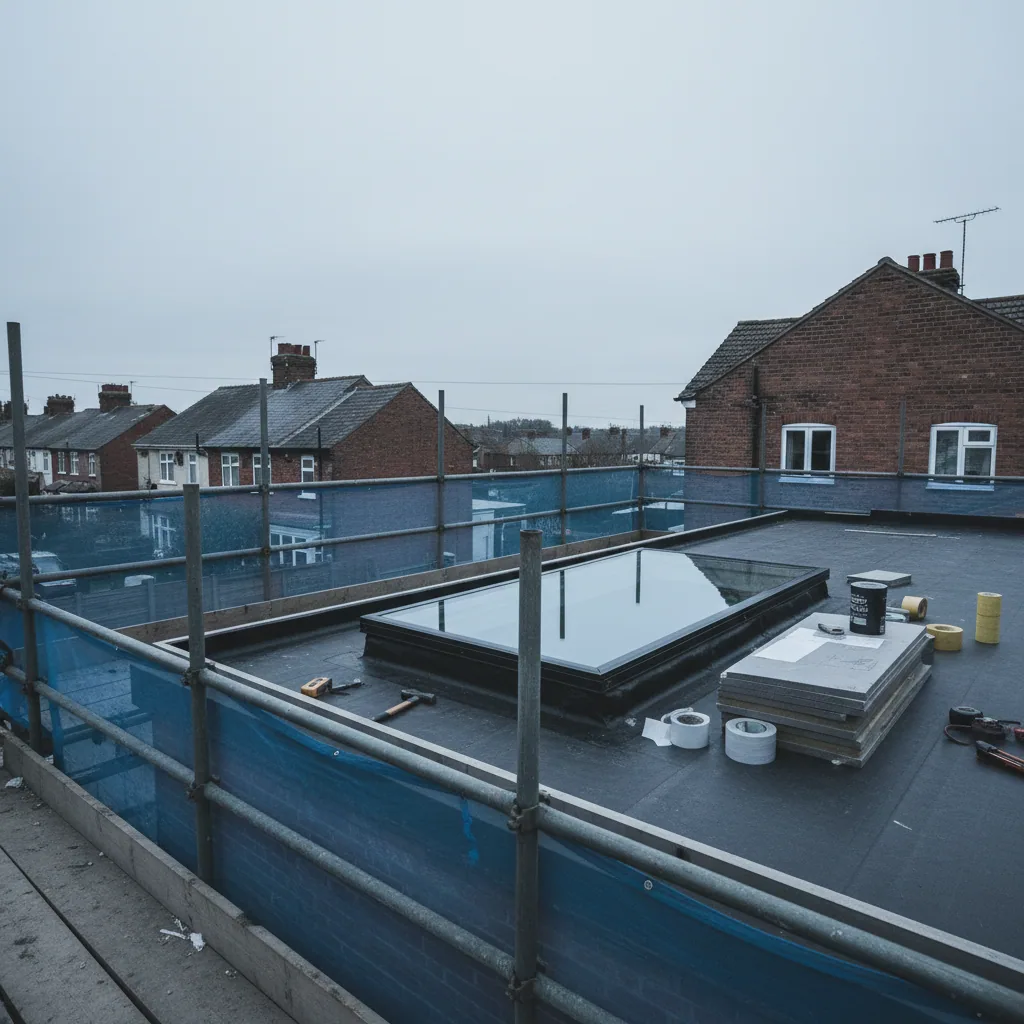
The same estates throw up a lot of single-storey rear extensions with flat roofs, which is where a flat roof rooflight or a roof lantern earns its keep. On a flat roof the critical number is the upstand height and the fall. We want the kerb standing proud enough that standing water and driven rain cannot reach the glazing seal, and a fall built into the deck so water leaves rather than ponds.

Part L, and why the older houses in town are harder to satisfy
Any new rooflight has to meet the U-value required under Part L for a new opening. A modern double or triple-glazed unit with a warm-edge spacer and a thermally broken frame gets there comfortably. Conservation-style units are the ones worth checking, because a slim frame gives you less room for thermal break, and the glazing specification has to do more of the work. Some conservation ranges hit the number easily and some need the upgraded glazing option. We check the declared figure against the requirement before ordering, not after. There is more on the numbers under energy efficient skylight installation.
Worth knowing: a rooflight that is not visible from any public place still needs listed building consent if the building is listed. Visibility affects what a conservation officer will accept in a conservation area. It does not exempt you on a listed building.
The medieval grid, and why the officer sees the whole street
The centre of Bury St Edmunds is one of the best-preserved medieval street grids in the country, laid out around the Abbey with the Abbeygate and the Buttermarket at its heart. That matters for a rooflight, because the control here is not only about individual buildings, it is about the townscape. A conservation officer looking at your roof is also looking at the run of roofs it sits in, and a modern window breaking a consistent historic roofline is exactly what the designation exists to prevent. So on a principal slope facing one of these streets the answer is almost always a flush conservation unit or nothing, and often the honest advice is a rear or concealed slope instead. The grid is tight and the buildings sit close, so what one roof does is visible in the context of its neighbours in a way it would never be on an open plot.
That does not make a rooflight impossible in the centre, only careful. Plenty of Georgian and older houses here have consented conservation units on rear or courtyard slopes, sitting flush in the plane of the covering where the street never sees them. The route to yes runs through the right slope, the right unit and an application that shows the officer you understand the setting. We survey, tell you which slopes we think will carry it, and quote for the version that stands a chance rather than the one that would look best from inside.
The fringe estates are a different town
Out beyond the ring road the picture changes completely. The large modern estates that have grown on the Moreton Hall and Howard sides, and the continuing expansion around the edges of town, are trussed, tiled and unrestricted. No conservation area, no listing, engineered roofs at regular centres, and a standard roof window that drops between the trusses in a day. These are among the quickest jobs we do, and they sit a short drive from roofs where every intervention is a consent conversation. It is why the same question, what rooflight can I have, gets two completely different answers depending on which side of the ring road you live, and why we ask for the street before we say anything useful.
Getting a price in Bury St Edmunds
Every job is surveyed on the roof and priced once in writing, and the figure does not move unless the specification does. Installations carry a 10-year workmanship guarantee and are installed to current Building Regulations. Where consent is needed we will tell you that at survey rather than after you have paid a deposit.
We cover this side of the county from Thurston and Elmswell across to Ixworth. The full list is on areas we cover.
Request a fixed quote for a rooflight in Bury St Edmunds. Tell us the street and whether the property is listed, and we can usually say straight away which of the two jobs yours is.
I live in the Bury St Edmunds conservation area. Can I have a rooflight at all?
Usually yes, but the type is constrained rather than free. Conservation areas remove or reduce permitted development rights for roof alterations, so you are looking at a conservation-style unit that sits flush in the plane of the covering, with a slim dark frame and a central glazing bar. Rear and side slopes that are not visible from the street get an easier ride than a principal elevation facing the road. We survey and tell you what the roof will physically take before you approach the council.
My house is on one of the newer estates outside the town centre. Is it a simpler job?
Considerably. Modern estate roofs are trussed at regular centres, most commonly 600mm, so a standard-width roof window fits between two trusses with no structural alteration at all. No consent is normally needed as long as the unit projects no more than 150mm above the roof plane and sits below the ridge. It is the quickest kind of rooflight installation we do.
You are over twenty miles away. Does that add to the cost?
No. Bury is a regular run for us and it is nearly all A14, around forty to fifty minutes each way. Survey visits and the installation itself are priced the same as they would be in Ipswich. What we do ask is a bit of flexibility on the survey date so we can group the western jobs together.
Can you cut into a truss to make my rooflight wider?
Not without a structural engineer designing a replacement support, and at that point the cost usually outweighs the extra width. A trussed roof is an engineered system where every member is carrying calculated load. The sensible answer on most Bury estate roofs is either a unit that fits the trussed bay, or two units in adjacent bays, which often gives better light distribution anyway.
Why is a rooflight on the front of my town-centre house so hard to get approved?
Because the medieval grid around the Abbeygate and the Buttermarket is protected as a townscape, not just building by building. A conservation officer looking at your roof is also looking at the run of roofs it belongs to, and a modern window breaking a consistent historic roofline is exactly what the designation exists to prevent. On a principal slope facing one of these streets the answer is a flush conservation unit or, often, a rear slope instead. The buildings sit close together, so what one roof does is read in the context of its neighbours.
Can a rooflight go in a hand-cut Georgian roof, or is the structure too irregular?
It can, but the trimmers are sized to what is actually there rather than to a table. Georgian roofs in Bury are frequently hand-cut, with rafters that vary in depth and spacing along the same slope, so forming an opening usually means cutting a rafter and framing above and below it. We open up, measure the real spans and size the support to them. Where the structure is historic and cutting it is not acceptable, we look for an existing bay wide enough to take a narrow unit without touching a rafter, which plenty of these roofs will give you if you look.
Thinking about this job? We survey across Ipswich, Suffolk and north Essex and give you a fixed price before any work starts, with a 10-year workmanship guarantee.