Skylight Installation in Chelmondiston
- Fixed quote before we start
- Roof never left open overnight
- 10-year workmanship guarantee
- Fixed quote before we start
- 10 years workmanship guarantee
- 25 years fitting rooflights
- Skylights only, not a general roofer
Chelmondiston runs down to the water at Pin Mill, where the barge quay and the hard have been in use longer than anything on the road above. Properties here sit in a genuinely damp micro-climate: tidal mud, saturated air off the Orwell for much of the year, and tree cover on the slope that keeps roofs from drying out after rain. That combination is the thing to design around.
Just over six miles from Ipswich, so twenty minutes down the B1456 along the south bank. Not far, but the last part of the lane down to Pin Mill is steep and narrow, and access is worth discussing before scaffold is booked.

Condensation is the failure mode here, not rainwater
Most people assume a rooflight problem is a leak from outside. In damp locations a good proportion of the water that appears around a rooflight never came from the sky. It came from the room, as warm moist air, and condensed when it reached a cold surface inside the roof build-up.
The mechanism is straightforward. A bathroom or kitchen generates water vapour. That vapour moves towards the colder side of the construction. If it can get past the plasterboard into the insulation zone or the reveal void, it hits a surface below dew point, turns back into liquid, and sits there. You see damp staining at the corners of the plasterboard reveal, sometimes mould on the frame, and it looks exactly like a leak.
Chelmondiston loads the dice on this. Ambient humidity is high, roof slopes stay wet longer under tree cover, and older cottage construction rarely has a continuous vapour control layer to start with.
Sealing the reveal properly
The detail that fixes it is not exotic, it is just often skipped because it is fiddly and invisible once the plaster is on.
- Continuous vapour control layer. The VCL on the warm side of the insulation has to be carried up to the rooflight frame and sealed to it, not simply cut off at the edge of the opening. A gap of a few millimetres all the way round is a permanent open route for vapour.
- Tape, not staples alone. Laps in the VCL and the junction with the frame are taped with a proper airtightness tape. Staples hold the sheet, they do not seal it.
- Insulation carried into the reveal. The reveal is a thermal bridge if it is left as bare timber and plasterboard. Insulating the reveal keeps the internal surface temperature above dew point, which is what actually stops the condensation forming.
- Splayed reveals. Angling the plasterboard reveal, wider at the room side, improves the light spread and lets air wash across the glass, which reduces surface condensation on cold mornings.
Ventilation is half the answer
You cannot seal your way out of a moisture problem if the moisture has nowhere to go. Where a rooflight is going into a bathroom, a kitchen or a converted loft, the room needs adequate extract or purge ventilation. Building Regulations Part F sets what is required for a new or altered room. An openable rooflight contributes usefully to purge ventilation, and in a room with no other opening it may be the only route available.
This is a reason we often recommend an opening unit here over a fixed one, even when the customer only wanted light. A fixed pane in a damp room in a damp village is a surface waiting for water to collect on it.
What suits the stock
- Cottage slopes, mostly steep and tiled, take a straightforward pitched roof skylight installation. Steep pitch is an advantage: water clears fast and the slope dries quicker.
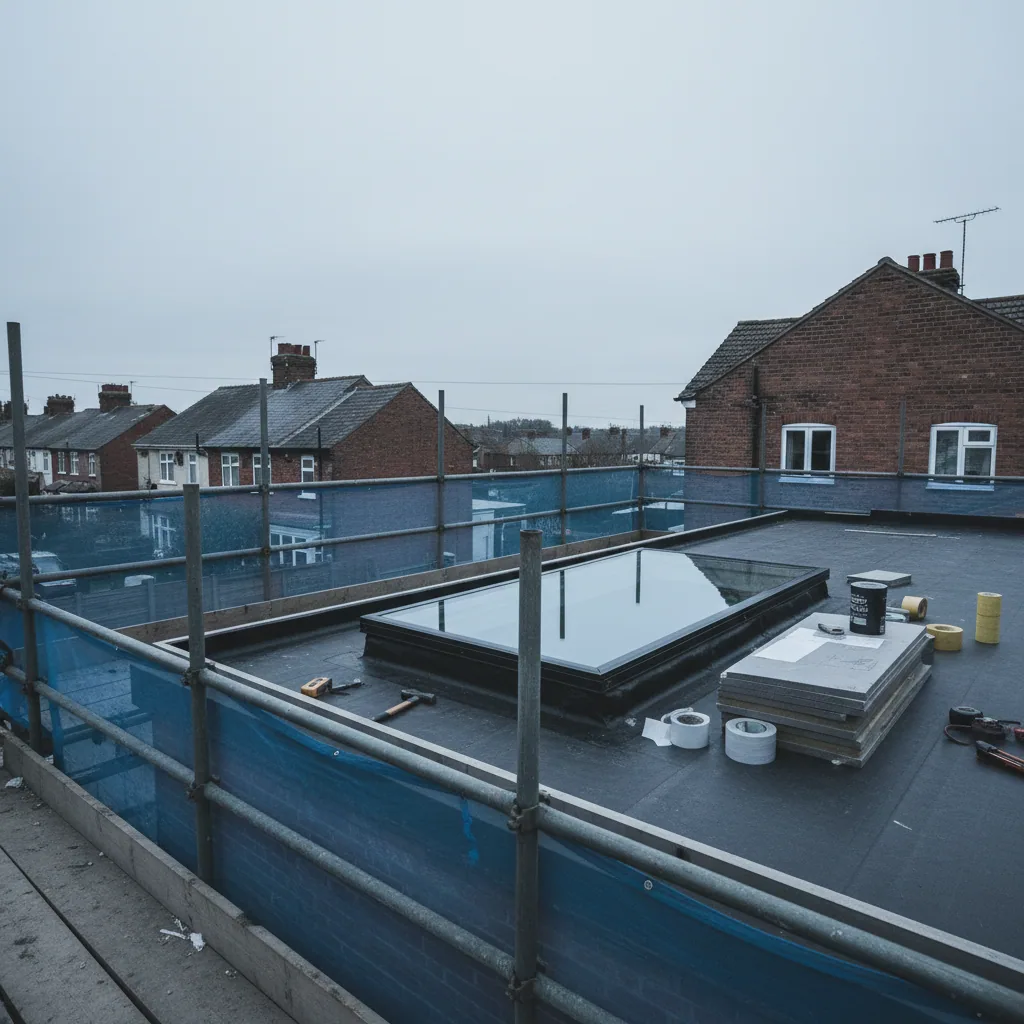
- Rear outshuts and later extensions with low-pitch coverings need a kerb and a flat roof rooflight with a built fall.
- Openable units earn their place here. An electric skylight installation with a rain sensor closes itself when the weather turns, which matters when the unit is above a stair and out of reach.
- Modern glazing at around 1.2 W/m²K with a warm-edge spacer keeps the internal glass surface warmer and therefore drier. See energy efficient skylight installation.

If you already have staining round an old rooflight: before assuming the unit has failed, check whether the damp is worst in winter and worst in the corners of the reveal. That pattern points at condensation and a broken vapour path rather than a leak. It changes what needs doing. We diagnose it at survey rather than guessing from photographs.
Exposure on the Orwell south bank
Chelmondiston sits on tidal saline water. Salt loading is moderate, the sort you get on an estuary rather than an open coast, but wind funnels along the channel and slopes facing the water get driven rain regularly. We specify stainless fixings on water-facing elevations and check the flashing finish. Full marine specification is reserved for genuinely open-coast addresses, and claiming otherwise here would be overselling.
The Pin Mill setting and what it adds to a rooflight
Pin Mill sits within the Suffolk Coast and Heaths National Landscape, and the older waterside cottages include listed and locally significant buildings in a tightly grouped, much-photographed setting. That matters for a rooflight in two ways. On a listed cottage, consent is needed and a flush conservation-pattern unit is the realistic specification, as it is on the heritage stock across the water. On an unlisted cottage within the designated area, the constraint is usually about the visible slope, so a rear or concealed pitch is the sensible target. We check the designation at enquiry and tell you at survey which category you are in, so the design starts from what is allowed rather than from a product already chosen.
Reading an existing damp problem before quoting
A good share of Chelmondiston enquiries come from a homeowner who thinks an old rooflight is leaking. Part of the survey here is establishing whether it actually is. We look at where the staining sits and when it appears: damp at the corners of the plasterboard reveal, worst in winter, points at condensation and a broken vapour path rather than rainwater, while a stain that tracks from one edge after rain points at a flashing or seal failure. The two need different work, and on a damp, tree-shaded slope that dries slowly the condensation case is common and easily misread. Getting the diagnosis right is the difference between a replacement that solves the problem and one that repeats it, because a new unit fitted over an uncorrected vapour path will stain again in the first cold spell.
The covering on the older cottages here is mostly a steep clay tile, which is a help in a damp spot because the pitch clears water fast and the slope dries sooner after rain. The later outshuts and rear additions are the wetter part of the picture, often low-pitch and slower to drain, and it is on those that the reveal and ventilation detail earns its keep. We match the flashing kit to whichever covering is actually on the slope, measured on the roof.
Tree cover, and keeping a roof clear
The wooded slope that gives Pin Mill its character also drops a steady load of leaf litter and debris onto the roofs below it, and that has a bearing on a rooflight. The side gutters formed by the flashing have to shed water, and where they silt up with leaves and moss the water backs up under the covering instead of running off. On a damp, shaded slope that never quite dries, that debris breaks down slowly and holds moisture against the tiles, so we set the flashing so it clears rather than collects and we point out where an overhanging branch is going to keep a new unit permanently shadowed and damp. A rooflight under heavy tree cover also stays cooler than one in the open, which brings the condensation question back into play, so the reveal detail and the ventilation matter that bit more. Where a customer can cut back an overhang before the work, it is usually worth doing, because a slope that gets a little more air and light around the unit stays drier and cleaner between visits. We flag all of it at survey rather than leaving you to find out which branch was the problem the first wet autumn after the job.
Getting a price
Surveyed on site, priced once in writing, and the figure holds unless the specification changes. Ten-year workmanship guarantee, installed to current Building Regulations. New installations and full replacements only.
We cover the rest of the peninsula at Holbrook and Shotley Gate, and across the water at Nacton. The whole list sits on areas we cover.
Request a fixed quote for Chelmondiston or Pin Mill. Mention if the room below is a bathroom or kitchen, because that changes the reveal detail and the ventilation requirement.
We get damp round our existing rooflight at Pin Mill. Is it leaking?
Possibly not. In a damp location like this, staining at the corners of the plasterboard reveal that is worst in winter usually points to condensation rather than rainwater. Warm moist air from the room reaches a cold surface inside the construction and condenses. The cure is a continuous vapour control layer sealed to the frame, insulation carried into the reveal, and adequate ventilation in the room. We work out which cause it is at survey.
Should we choose an opening rooflight or a fixed one here?
In this village we lean towards opening, even where the customer only asked for daylight. Humidity is high, roofs stay damp under tree cover, and rooms need a route for moisture to leave. Part F sets ventilation requirements for new and altered rooms, and an openable rooflight contributes to purge ventilation. If the unit is out of reach above a stair, an electrically operated one with a rain sensor is the practical version.
Is access down to Pin Mill a problem for scaffold?
It needs planning rather than being impossible. The lane down is steep and narrow, and some properties have restricted frontage. We check vehicle access and scaffold positioning at survey and factor it into the quote, so there are no surprises about a lorry that cannot turn. It occasionally means a tower and a longer fit rather than full scaffold.
Do Chelmondiston roofs need marine-grade fixings?
Not usually the full marine package. This is an estuary, so salt is present but the loading is moderate compared with an open-coast address. We upgrade to stainless fixings on slopes facing the Orwell and check that the flashing finish suits the aspect. That handles the corrosion risk here without charging you for a specification the site does not need.
Is Pin Mill a conservation area, and does that stop a rooflight?
The area is within the Suffolk Coast and Heaths National Landscape and includes listed and locally significant cottages, so designation is worth checking, but it rarely stops a rooflight outright. On a listed cottage you need consent and a flush conservation-pattern unit; on an unlisted one within the designated area the usual route is a rear or concealed slope. We confirm which applies at enquiry so the design suits the constraint from the start.
How do you tell whether our old rooflight is leaking or just damp?
By where and when the water shows. Staining at the corners of the reveal that is worst in winter usually means condensation from a broken vapour path, while a stain tracking from one edge soon after rain usually means a failed flashing or seal. The two need different work, and in a damp, shaded spot like Pin Mill the condensation case is common and often mistaken for a leak. We establish which it is at survey before quoting, so the replacement actually fixes the cause.
Does a slow-drying, tree-shaded roof need anything different?
It reinforces the case for getting the reveal and ventilation right. A slope under tree cover stays damp longer, which keeps the internal surfaces cooler and closer to the point where condensation forms, so the vapour control layer sealed to the frame, insulation carried into the reveal and adequate room ventilation all matter more here than on an open, quick-drying roof. The corrosion side stays at the estuarine level: stainless fixings on the water-facing slopes rather than a full marine package.
Thinking about this job? We survey across Ipswich, Suffolk and north Essex and give you a fixed price before any work starts, with a 10-year workmanship guarantee.