Skylight Installation in Dunwich
- Fixed quote before we start
- Roof never left open overnight
- 10-year workmanship guarantee

- Fixed quote before we start
- 10 years workmanship guarantee
- 25 years fitting rooflights
- Skylights only, not a general roofer
Dunwich is a small place with a very large history. What is left today is a hamlet of a few dozen properties on a low cliff and the marshes behind it, the surviving edge of what was once one of the largest ports on the east coast before the sea took most of it. The erosion is not a story from a guidebook. It is the reason the ground here ends in a cliff face, and the reason the exposure on this stretch is about as severe as the Suffolk coast gets.
It is 25.4 miles from Ipswich in a straight line, and around fifty minutes on the road, up the A12 and out through the heath and forest on the small lanes past Westleton. A long way for a hamlet, and we will not pretend otherwise, but the work here genuinely needs someone who treats the exposure as the starting point rather than an afterthought.

Two forces, not one: wind uplift as well as salt
On a fully exposed cliff top, salt corrosion is only half the problem. The other half is wind. With nothing upwind to break it, a gale off the North Sea hits a roof here at close to its full speed, and the pressure it generates does not just push on the roof, it lifts. Air accelerating over the ridge and around a projecting rooflight creates suction on the leeward side, and that uplift tries to pull the unit and its fixings out of the roof.
Most inland rooflight fixings are specified for inland wind loads. On an exposed cliff the load is in a different band entirely, and the answer is not one heroic screw but the right fixing at the right frequency into sound timber, so no single fixing carries more than it should. We check the timber the unit lands on at survey, because a strong fixing into a soft or split rafter is no fixing at all.
Why the corrosion specification is not optional here
Unfiltered salt off the open sea is the harshest chloride environment we deal with. It arrives as fine spray on the wind, settles on every surface, and concentrates in exactly the places nothing rinses it away: under a flashing lap, at a fixing head, along the edge seal of a sealed unit.
- 316L marine-grade stainless throughout, the molybdenum-bearing grade that resists chloride pitting, on every fixing including the buried ones under the tiles. A2 stainless pits and loses strength at the point of attack, out of sight, until something moves.
- Marine-specification coating on any aluminium frame, because standard polyester chalks and then lifts under combined salt and UV, and here it gets the maximum dose of both.
- Flashing laps set deeper than the inland minimum, since driven rain on this cliff arrives horizontally and pressure-drives water back up the overlap.
Belt and braces, on purpose: some of what we do at Dunwich would look like over-specification twenty miles inland. It is not over-specification here. This is the worst case on our patch, and the sensible thing to do with a worst case is design for it rather than hope the weather is kind.
The whole assembly to one standard
A rooflight is a frame, a coating, a sealed unit, a flashing set, an upstand and dozens of fixings, and corrosion finds the weakest of them. Fit a marine-coated frame with the A2 screws that came in the box and the screws set the life of the job. On an exposed cliff there is no point protecting one layer to marine grade and leaving the next at inland standard, because the sea attacks all of them at once.
Replace, never patch
When a unit here fails, patching it is the poorest value on the whole coast. The edge seal of a sealed unit is a chemical barrier that chloride destroys, and once it has gone no external sealant restores it. A cliff-top patch might survive one winter. We replace the unit and correct the fixings, the flashing and the upstand together, all to the coastal standard, so the assembly matches and nothing weak is left behind to fail first.
What we fit here
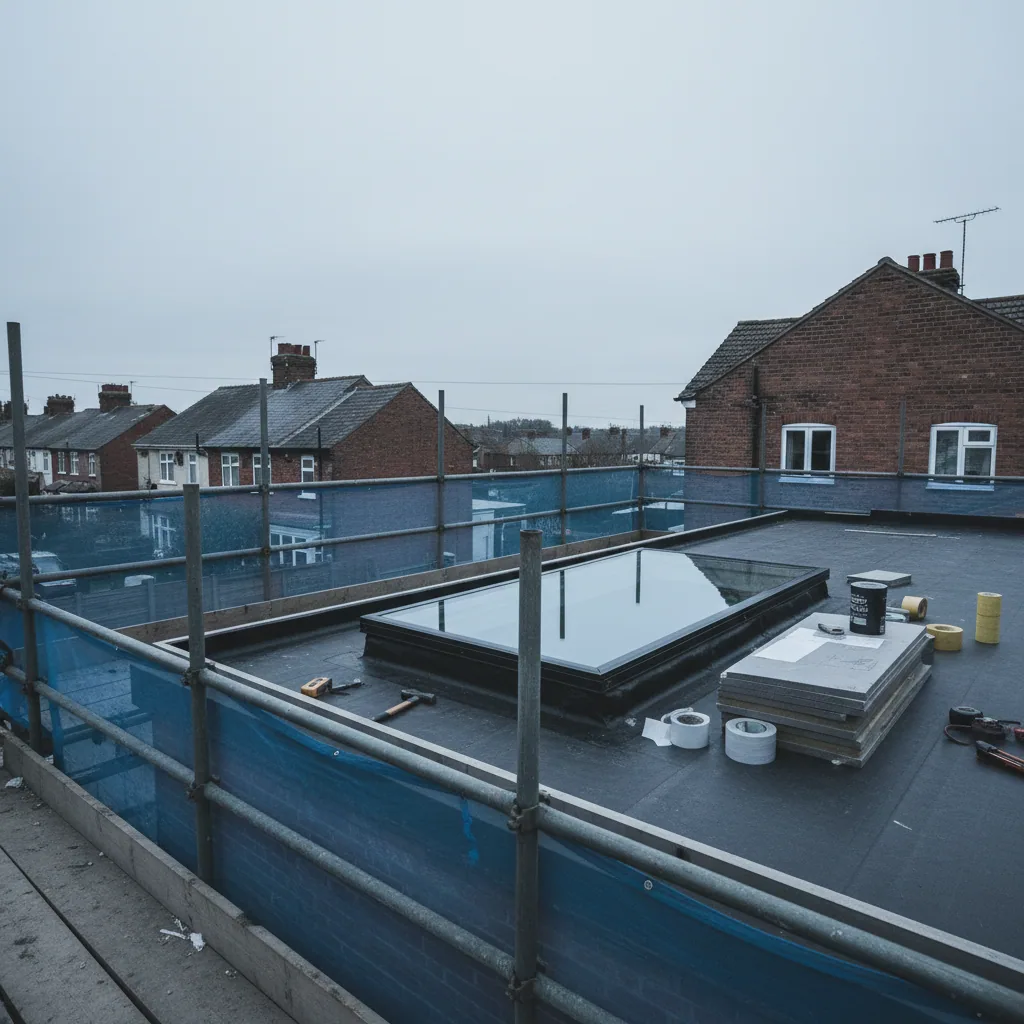
The stock is modest and traditional, so most work is a straightforward pitched roof skylight installation, or a VELUX, Keylite or Roto unit into a converted roof, all in the coastal specification. Where a low rear extension is involved, a flat roof rooflight on a properly built kerb does the job, and the glass is worth getting right, so see energy efficient skylight installation.
What the survey has to establish here
On a cliff-edge plot the survey is as much about the timber as the covering, because the fixings that hold a rooflight down against uplift are only as good as the wood they bite into. We go into the roof space and check the rafters the unit will land on: their size, their spacing, and whether any are split, soft with old damp, or already notched by a previous cable or pipe run. A textbook fixing into a poor rafter is a poor fixing. Where the timber is marginal we add noggins or double a rafter so the load is carried properly, and that is designed at survey rather than improvised on the day.
Aspect comes next. There is little shelter anywhere in the hamlet, but a slope facing directly onto the sea takes both the salt and the uplift at their worst, while a slope in the lee of the ridge takes the uplift as suction from the other side. We read the fetch, the pitch and the covering together and specify from what is actually in front of us, because on the most exposed stretch of the patch a standard kit chosen from a catalogue is not a specification, it is a guess.
The stock itself is modest and traditional, mostly brick or rendered cottages under plain tile or pantile, with none of the listed density of a Southwold or a Walberswick. That keeps the heritage question simpler here, so the survey concentrates on the two things the position actually throws at the roof, the salt and the wind, rather than on consent.
Glazing chosen for the wind, not just the frame
On an exposed cliff the glass specification earns its keep as much as the fixings do. For a larger unit in a fully exposed slope we would specify a laminated inner pane, so that in the unlikely event of a pane being struck by wind-borne debris it holds together rather than falling into the room. On an opening rooflight we set the restrictor and the hinge friction for a windy site, because a vent that swings freely in a gale is a vent that strains its stays. These are small choices made at specification stage, and they cost far less then than a callout to a unit that has been over-worked by the weather.
Working to the forecast on an open cliff
One practical thing separates a fit here from an inland one: you do not open a roof up on a bad forecast. On a sheltered site a covering can be off for a few hours in a stiff breeze without much thought. On an exposed cliff a strong onshore wind makes lifting tiles and handling a large glazed unit both slower and less safe, and driven rain across an open opening finds its way into a roof space fast. So we watch the forecast and plan the stage of the work that leaves the roof open for a settled window, keeping the more weather-tolerant tasks for the windier days. It occasionally means a fit here takes a little longer to programme than the same job twenty miles inland, and we would rather say that plainly than promise a date the weather cannot keep. Once the unit is in and the flashings are dressed and fixed the roof is as weathertight as any, and the specification is chosen precisely so it stays that way through the worst the position throws at it. The care is in getting it closed up properly in the first place, and on this coast that means working with the weather rather than against it.
Getting a price in Dunwich
Every job is surveyed on the roof and in the roof space, then priced once in writing. The figure holds unless the specification changes. Installers with 25 years in the trade, a 10-year workmanship guarantee, installed to current Building Regulations.
We work the same coast at Walberswick and Southwold just up the shore, and inland at Saxmundham. The full list is on areas we cover.
Request a fixed quote for a rooflight in Dunwich. Tell us how exposed the plot is and which way the roof faces, and we can be useful before the drive up.
Is Dunwich too exposed for a rooflight at all?
No, but it is the most exposed spot we cover, and the specification has to respect that. Salt corrosion and wind uplift are both severe here, so we use 316L marine-grade fixings at the right frequency into sound timber, marine coatings on any aluminium, and deeper flashing laps than inland. Done to inland specification a rooflight fails from the outside in, usually starting at a buried fixing nobody can see.
What is the wind issue with a rooflight up here?
On an exposed cliff a gale hits the roof at close to full speed, and air accelerating over and around a projecting unit creates suction that tries to lift it out. That uplift is a real structural load, higher than the inland band most fixings are chosen for. The answer is the right fixing at the right spacing into timber we have checked is sound, so no single fixing is overloaded. We assess this at survey rather than assuming a standard kit will do.
Why replace a unit instead of resealing it?
Because on this coast a reseal buys one winter at most. Once the edge seal of a sealed unit has failed, the argon is gone and moisture is inside, and that is a chemical failure no external sealant reverses. We replace the unit and put the fixings, flashing and upstand right at the same time, all to marine specification, so the whole assembly is sound rather than one patched layer waiting to fail again.
It is a long way from Ipswich. Is it worth calling you out?
The distance is honest, around fifty minutes each way, and we would rather say so than pretend. What Dunwich needs is someone who treats severe exposure as the design starting point, not a footnote, and specifies fixings, coatings and flashing for a worst case. The drive does not change the price of the work, and we survey on site because on a cliff like this the right specification depends on things only a proper look reveals.
Should the glass itself be different on a plot this exposed?
For a larger unit on a fully exposed slope, yes. We specify a laminated inner pane so that a pane struck by wind-borne debris holds together rather than dropping into the room, and on an opening rooflight we set the restrictor and hinge friction for a windy site so the vent is not strained in a gale. These are specification choices, made before anything is ordered, and they cost far less than dealing with a unit that the weather has worked loose.
Do you need to strengthen the roof timbers for a rooflight up here?
Sometimes, and it is cheaper to know at survey. The fixings resisting uplift are only as sound as the rafters they land in, so where a rafter is split, soft or already notched we add noggins or double it before fitting rather than trusting a fixing into weak timber. On most Dunwich roofs the structure is sound and no strengthening is needed, but on this coast we check rather than assume, because a fixing is worthless if the wood behind it is not.
Thinking about this job? We survey across Ipswich, Suffolk and north Essex and give you a fixed price before any work starts, with a 10-year workmanship guarantee.