Skylight Installation in Waldringfield
- Fixed quote before we start
- Roof never left open overnight
- 10-year workmanship guarantee

- Fixed quote before we start
- 10 years workmanship guarantee
- 25 years fitting rooflights
- Skylights only, not a general roofer
Waldringfield runs down to the Deben, and the houses that face the water take a beating from a wind that has crossed a wide open channel with nothing on it. It is a sailing village, so the exposure is not news to anyone who lives there. What is less obvious is how much of a rooflight installation is decided by uplift rather than by rain.
Six miles from Ipswich, twenty minutes out through Martlesham and down the lanes. Survey visits are straightforward, though the last stretch is single-track in places and a scaffold lorry needs a plan.

Wind uplift is the load nobody quotes for
Water gets the attention because a leak is visible. Uplift is quieter and does more damage over time. Wind flowing over a roof produces suction on the surface, strongest at the eaves, the verges and the ridge. On a house with a long unobstructed fetch across tidal water, that suction is meaningfully higher than on the same house in the middle of a housing estate where neighbouring roofs break up the flow.
A rooflight is a discontinuity in the roof surface. It sits slightly proud, its flashing has edges, and edges are where wind gets purchase. The consequences of under-fixing are not dramatic: nothing flies off. What happens is that the flashing works loose over a few seasons, the lap opens a fraction, and driven rain finds the gap on the one night a year the wind sits in the wrong quarter.
What we do differently on an exposed Deben slope
- Fixings at tighter centres. Manufacturer instructions give a standard fixing pattern for the frame brackets. On exposed sites we use the full complement rather than the minimum, and check the fixing lands in solid timber rather than the edge of a batten.
- Flashing clipped, not just dressed. The side and head flashings on a proprietary kit are designed to be mechanically retained. Dressing them into the tile profile neatly is not the same as clipping them, and on a sheltered roof you might get away with the difference. Here you will not.
- Batten and tile condition checked around the opening. If the battens either side of the new opening are perished, the tiles that clip back around the flashing have nothing to hold them. That is found by lifting tiles at survey, not by looking from the garden.
- Stainless fixings on water-facing elevations. The Deben is tidal saline water, so salt loading is moderate rather than severe. Upgraded fixings are a sensible precaution here, not the full marine specification we would use at an open-coast address.
Riverside stock: a mix, and each part behaves differently
There is no single Waldringfield roof. Older village properties sit on plain tile or Suffolk pantile with steep pitches and hand-cut structure. Later twentieth-century houses on the slope carry concrete interlocking tiles at shallower angles. Both are common and they want different things.
Pantile is the one people underestimate. It is a double-curve profile with a big roll, and the flashing kit has to be the profiled sort with a deep skirt that dresses into the roll. A plain-tile skirt on pantile leaves a void along the side flashing, and sealing that void is not a weathering detail, it is a countdown. Getting the covering identified correctly at survey is the whole game, which is why we lift a tile rather than judge from a photo.
What we fit here
- Pitched roof skylight installation on the steeper village stock, with the flashing kit ordered to match the actual covering measured on site.
- Roof lantern installation on rear extensions where the room is wide enough to justify the structural opening and the view across the river is worth framing.
- VELUX, Keylite and Roto units where a standard roof window is the right answer, which is most of the time.
- Energy efficient skylight installation when the room is south or west facing, because solar gain over the water can be more of a nuisance here than heat loss.
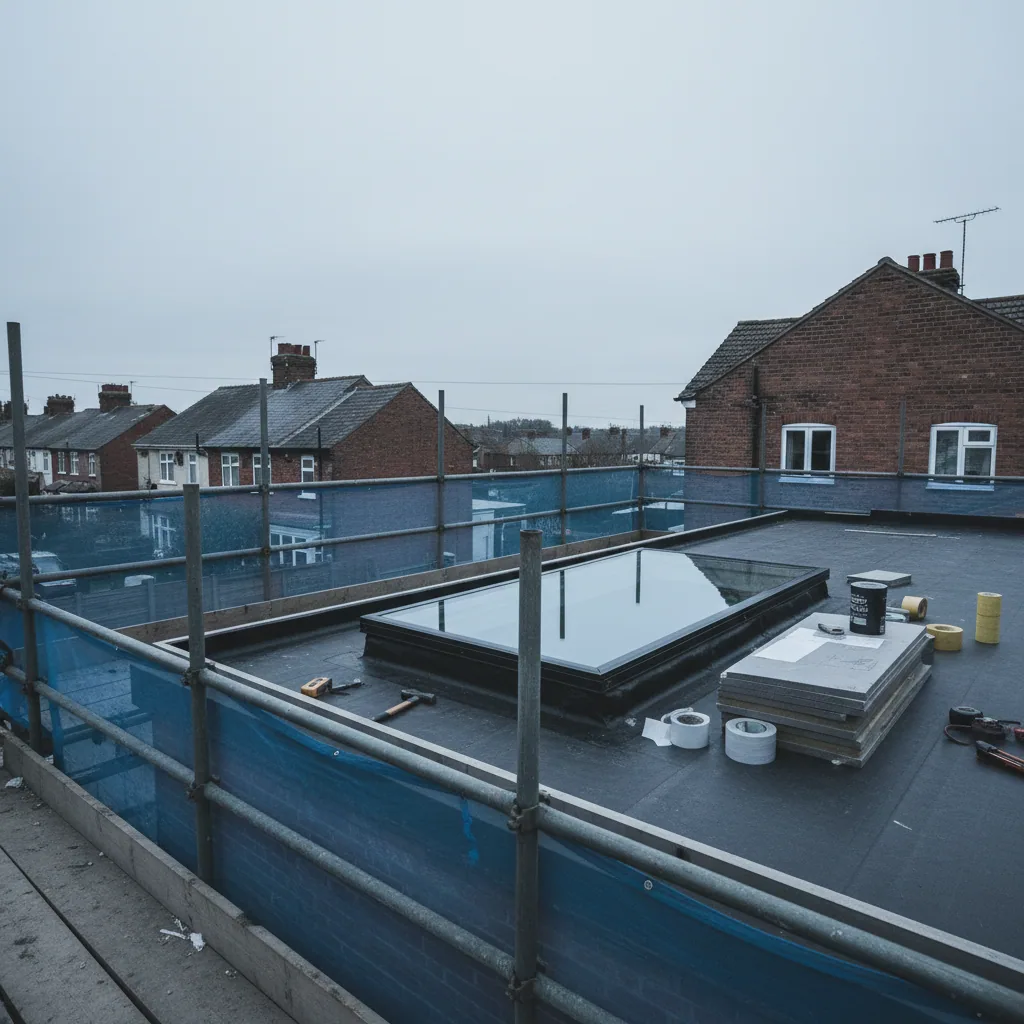
On solar gain: a large area of glass facing west over open water collects a lot of afternoon heat in summer. A solar-control or laminated coated glazing unit with a lower g-value handles that at the point of specification. Adding a blind afterwards treats the symptom and costs more in total.
What the survey settles on a windward roof
On the exposed Deben slopes the survey concentrates on the parts of the roof that uplift actually works loose. We lift tiles beside the intended opening to check the battens, because a fixing or a clipped-back tile is only as good as the batten behind it and salt-laden wind finds perished timber first. We check the verge and eaves details, since these are where suction peaks and where a poorly held tile lifts before anything else does. And we read the aspect, because a slope with a long open fetch across the tidal water wants the full fixing complement and clipped flashings, while a slope tucked behind the ridge can take a lighter touch. Deciding that on the roof, tile in hand, is the whole point of surveying rather than quoting from a photograph. Where the covering turns out to be Suffolk pantile, we also note the tile module, because aligning the opening width to it keeps the side flashings sitting in the same relative place both sides rather than one landing mid-roll.
Framing the river without fighting the weather
Waldringfield is a sailing village, and a lot of the enquiries here are about light and a view over the water rather than a simple loft window. That is a fair thing to want, but the most exposed, best-view elevation is also the one the wind tests hardest, so the two pull against each other. A large glazed area on a windward slope is not ruled out, but it is specified accordingly: the fixing pattern, the flashing lap and, on a big unit, a laminated inner pane all follow from putting glass where the weather is strongest. Where the view can be caught from a slightly less exposed slope, or from a lantern on a rear extension that sheds water by its own shape, that is often the better trade, and we will say so at survey.
Aspect also drives the glass. A west-facing unit over open water collects strong late-afternoon sun, so a solar-control coating with a lower g-value is specified from the start rather than solved with a blind afterwards, and a windward north or east slope is specified instead for keeping heat in. The same view can want opposite glass depending on which slope it is caught from.
Getting scaffold down the lanes
The approach to the waterfront is single-track in places, and a scaffold lorry needs a plan rather than a hopeful turn-up. We check access at survey and decide whether full scaffold or a tower suits the property and the frontage, and we build that into the fixed quote. It occasionally means a longer fit where a tower is the only sensible way in, and knowing that in advance is better than a lorry that cannot reach the house.
A working sailing village
Waldringfield is busy on the water through the season, and the lanes down to the river and the boatyard carry more traffic in summer than the map suggests. Booking scaffold and a fit in the quieter months usually makes for an easier job, with clearer access for a lorry and less disruption to a village that fills up when the boats are out. The riverside houses also tend to be lived in and loved rather than left empty, so access is generally straightforward to arrange, but the single-track approaches still reward planning the delivery and the lift in advance. We settle the timing and the access at survey so the work runs to a plan rather than around the village’s own calendar.
Getting a price in Waldringfield
Surveyed on the roof, priced once in writing, and the number holds unless you change the specification. Ten-year workmanship guarantee on the installation, fitted to current Building Regulations. Installers with 25 years in the trade behind them.
We work the same stretch of river at Ramsholt and up to Woodbridge, and across the peninsula at Nacton. Everywhere else is listed on areas we cover.
Request a fixed quote. Tell us which way the roof slope faces, because on this site the aspect changes both the fixing specification and the glass.
Is a rooflight a risk on a house this exposed to the Deben?
Not when it is fixed for the exposure. The failure mode on windy sites is not the glass, it is the flashing working loose under repeated suction until a lap opens. We use the full manufacturer fixing complement rather than the minimum, mechanically clip the flashings rather than only dressing them, and replace any perished battens around the opening so the tiles that clip back have something solid to hold. That detail is what makes the difference here.
Our roof is Suffolk pantile. Does that need a special flashing kit?
Yes. Pantile has a deep double-curve roll and needs a profiled flashing kit with a deep skirt that dresses down into the roll. A plain-tile kit bridges the roll and leaves a void that sealant will not close permanently. Kits are ordered with the window, matched to the covering we measure on site, so we lift a tile at survey rather than judging the profile from a photograph.
Do you use marine-grade stainless here?
Waldringfield is estuarine, not open coast. The Deben is tidal saline water with moderate salt loading, so we upgrade to stainless fixings on water-facing slopes but do not usually specify the full marine 316L and marine-coating package we would use at somewhere like Felixstowe or Aldeburgh. If your property is unusually exposed on the waterfront itself we will say so at survey and price the upgrade.
Will a big rooflight overheat a room facing the river?
It can, especially west facing over open water where late sun reflects. The fix belongs in the specification: choose a glazing unit with a solar-control coating and a lower g-value, which cuts the heat transmitted without making the room dim. Adding an external or integral blind later works but costs more overall than getting the glass right first time.
We want a rooflight to frame the river view. Is that sensible on an exposed slope?
It is, with the right specification. The best-view elevation is usually the most exposed, so a large unit there gets the full fixing complement, clipped flashings and, if it is a big pane, a laminated inner leaf. Sometimes the view can be caught from a slightly more sheltered slope, or from a lantern on a rear extension that sheds water by its own geometry, which is a better trade. We work through the options on the roof rather than committing to the windward slope by default.
Is access down to the waterfront a problem for scaffold?
It needs a plan rather than being impossible. The lanes down are single-track in places, so we check vehicle access at survey and decide whether full scaffold or a tower suits the property, then price it in. Occasionally a tower is the only sensible way in, which lengthens the fit slightly, but settling it in advance means no lorry turns up to a lane it cannot manage.
How do we know the battens will hold a rooflight on a windy roof?
We check them. At survey we lift tiles beside where the opening will go and look at the battens and the fixing timber, because on an exposed slope a clipped-back tile or a flashing is only as sound as the batten behind it, and salt-laden wind perishes timber at the verges and eaves first. Where a batten is gone we replace it so the tiles that clip around the new flashing have something solid to hold, which is a routine part of the job here rather than an extra.
Thinking about this job? We survey across Ipswich, Suffolk and north Essex and give you a fixed price before any work starts, with a 10-year workmanship guarantee.