Skylight Installation in West Mersea
- Fixed quote before we start
- Roof never left open overnight
- 10-year workmanship guarantee
- Fixed quote before we start
- 10 years workmanship guarantee
- 25 years fitting rooflights
- Skylights only, not a general roofer
West Mersea sits at the seaward end of Mersea Island, joined to the mainland by the Strood, a low causeway that the spring tides still cover a few times a year. That single geographic fact shapes every roof on the island. This is not a seafront with a sheltered side behind it. It is a low island in the mouth of the Blackwater, open water to the south and west, the Colne approaches to the east, and salt air arriving from whichever way the wind is set that week.
It is 21.6 miles from Ipswich in a straight line, and realistically an hour on the road: down the A12, off at Colchester, then the B1025 across the Strood.

Why “which way does it face” is the wrong question here
On most of the coast we survey we can save a homeowner money by treating the seaward and landward slopes differently. The front pitch takes the salt and the driven rain, the back pitch sits in the lee of the ridge, and a rear rooflight sometimes does not need the full specification. That logic mostly fails on Mersea.
The island is low, flat and surrounded, so the wind that carries chloride onto a roof is not reliably coming from one quarter. A slope sheltered from a south-westerly is fully exposed to the north-easterly that follows it, and those north-easterlies off the sea are the ones that drive salt hardest. So on Mersea we tend to specify the whole roof to one standard rather than gamble that a particular slope stays clean. That is cheaper than replacing a unit under-specified on a guess about the prevailing wind.
Bungalows and chalets: low pitch, easy access, and a fixings problem
A great deal of Mersea’s stock is single-storey bungalow and chalet bungalow, a lot of it built through the middle of the last century as the island filled in. That stock brings two things to a rooflight job.
The good news is access. A single-storey roof is quick to reach and quick to scaffold, and the survey is straightforward because we can see the whole covering. The complication is pitch and exposure together. Bungalow roofs often sit at a shallow angle, and a shallow slope on an exposed island holds driven rain against the flashing longer than a steep one sheds it. That is the exact condition where a corroding fixing or a lifting flashing lap turns into a leak.
- 316L stainless fixings throughout, including every screw that disappears under the tiles when the covering goes back. A2 stainless, the grade in most flashing kits, pits in chloride and loses strength at the point of attack long before the head looks bad.
- Marine-specification powder coating on any aluminium frame. Standard architectural polyester chalks under salt and UV, then lets water under the coating at a cut edge.
- Flashing laps set deeper than the inland minimum, because on a low island the rain arrives horizontally and pressure-drives water back up the overlap.
Chalet bungalows add a wrinkle worth flagging. Many already have a room in the roof, sometimes with an original dormer. Adding a rooflight there means the unit is doing a fire-escape job under Part B as well as a daylight one, which sets a minimum clear opening and a reachable sill. We work that out on site rather than from a photograph.

Replace, do not patch, and on Mersea the reason is sharper
When a sealed unit mists or a flashing starts to weep, the temptation is a bead of sealant and another season bought. On an exposed island that is worse value than almost anywhere. Chloride attacks the edge seal of a sealed unit chemically, so once it has failed no external sealant restores the barrier. We replace the unit and correct the fixings, the flashing laps and the upstand at the same time, to one coastal standard.
What “coastal specification” means on a Mersea quote: marine-grade 316L stainless throughout, marine-specification coating on aluminium, deeper flashing laps than inland, and sealed units with an edge seal rated for the exposure. 316L is the molybdenum-bearing grade that resists chloride pitting. On this island it is the correct part, not an upgrade.
Where the light usually goes
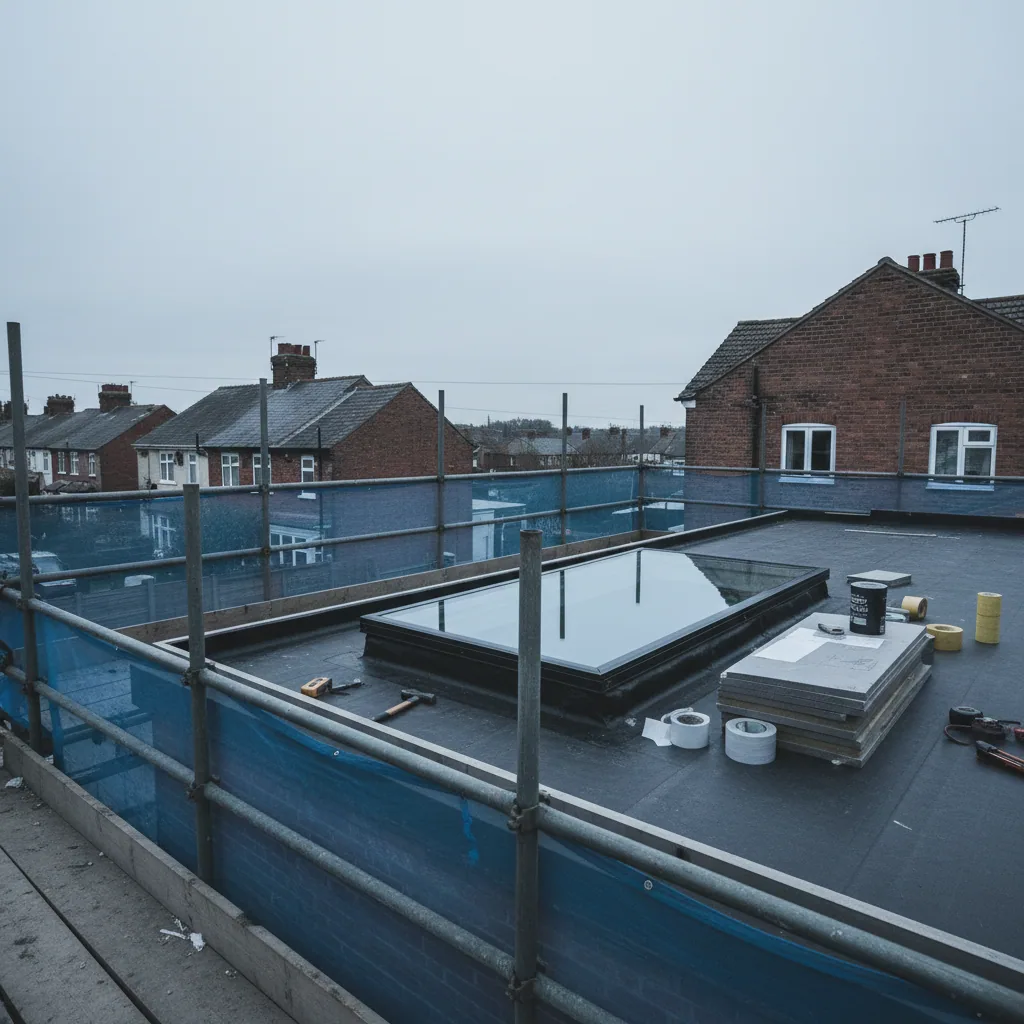
Most island projects are one of two things. Either daylight into a low bungalow, where a pitched roof skylight installation or a couple of VELUX, Keylite or Roto units spread light across a single-storey plan, or a rear extension where a flat roof rooflight on a properly detailed kerb, or a roof lantern, lights a new kitchen. Whatever the unit, the specification underneath it is set by the island, not the brochure.
What the survey checks on an island roof
Mersea filled in through the twentieth century as much by self-build and piecemeal extension as by any developer, so two houses on the same road can carry different coverings, different pitches and different underlay of very different ages. That variety is the reason we survey on the roof rather than price from a description. On a bungalow the covering is usually a concrete interlocking tile at a shallow angle, and the age of the underlay beneath it is the number that matters most, because a brittle bitumen felt that has been baking and salting for forty years tears as soon as it is disturbed around an opening.
We check three things in particular. The pitch, measured rather than guessed, because below about fifteen degrees a standard roof window needs its low-pitch collar and flashing kit or it does not weather. The condition of the battens either side of where the opening will go, since a clipped-back tile needs a sound batten to hold it and salt-perished battens are common here. And, on any flat-roofed rear addition, the fall of the deck, because a shallow island roof that ponds puts the rooflight kerb in standing water. None of that shows from the garden.
The upside of the low, simple stock is that setting out is usually forgiving. A single-storey roof with a straightforward covering gives room to shift an opening a course either way so the flashing lands cleanly, and access for scaffold or a tower is quick on a bungalow. The complications on Mersea are the exposure and the age of what is up there, not the shape of the roofs, and both are things a proper survey settles in an afternoon.
Piecemeal extensions and mixed coverings
A lot of island houses have grown a room at a time, and each addition tends to carry whatever covering was cheap and available when it went on. It is common to survey a single property and find the main roof on one tile, a 1970s extension on another, and an older outbuilding on corrugated sheet. Each of those needs its own flashing approach, and the flashing kit for one will not weather another. Where an older covering turns out to be a cement sheet product we flag it plainly, because that is a covering with its own handling requirements and not something to cut into casually. The point of saying all this at survey is that the quote reflects the roof you actually have rather than an average one.
Working to the tide, not just the diary
The one genuinely island thing about working on Mersea is the Strood. The causeway floods on the higher spring tides for a short window either side of high water, a few days each month, and while that is no obstacle to a planned job it does shape the logistics. We check the tide tables when we book a survey and a fit, so a scaffold lorry or a materials delivery is not left waiting at the mainland end of the causeway for the water to drop. For most jobs it makes no practical difference at all, because the closure is brief and predictable, but it is the kind of thing worth mentioning at the outset rather than discovering on the morning of the fit. It also means we tend to bring everything for a stage of the work in one load rather than relying on nipping back and forth across the Strood through the day. None of it changes the price or the standard of the work. It is simply how an island job is planned, and planning it properly is part of turning up ready rather than turning up hopeful.
Getting a price in West Mersea
Every job is surveyed on the roof and priced once in writing, and the figure holds unless the specification changes. Installers with 25 years in the trade, a 10-year workmanship guarantee, installed to current Building Regulations.
We cover the same water across the Blackwater at Tollesbury, over towards the Colne at Brightlingsea, and on the mainland at Colchester. The full list is on areas we cover.
Request a fixed quote for a rooflight on Mersea. Tell us whether the roof is a bungalow or a chalet, and roughly its pitch, and we can be useful before we cross the Strood.
Does the whole roof really need coastal specification, even the sheltered side?
On Mersea, usually yes. The island is low and surrounded by open water, so there is no slope reliably in the lee of the wind. A pitch sheltered from the south-westerly is exposed to the north-easterly off the sea, and those drive salt hardest. Rather than gamble on a wind that shifts, we specify the whole roof to one standard, which costs less than lifting a covering to replace an under-specified unit.
Our bungalow roof is quite shallow. Is that a problem on the island?
It changes the detail. A shallow slope holds driven rain against the flashing longer than a steep one, and on an exposed island that is the condition that finds a weak fixing or a short flashing lap. Most roof windows are rated from about 15 degrees, and below that we either use a low-pitch-rated unit with its specific collar and flashing kit, or build a kerb and set a flat-roof-type rooflight on it to create the fall. We measure the pitch at survey.
We have a chalet bungalow with a room already in the roof. Anything to know?
Yes. If that room is habitable, a rooflight there is likely to be the fire escape under Part B, which sets a minimum clear opening and a sill you can reach from the floor. It is not a free choice of size or position. We check the existing structure and the escape requirement at survey and specify a unit that satisfies both, in the island’s coastal specification.
Can you reach Mersea when the Strood floods?
Not while the causeway is under water, which happens on the higher spring tides for a short window either side of high water. We plan visits around the tide tables, so it makes no practical difference to a job. Worth a mention when we arrange the survey, so nobody is left waiting at the wrong end of the Strood.
Our bungalow has been extended more than once. Does the mix of roofs complicate a rooflight?
It affects the detailing rather than the feasibility. Each covering needs its own flashing kit matched to its profile, so we identify what is actually on each part of the roof at survey rather than assuming one type throughout. If an older addition or outbuilding carries a cement-sheet covering we will say so, because that changes how it is handled. The rooflight itself still goes into whichever slope suits the room, in the island’s coastal specification.
Is a shallow bungalow roof suitable for a roof window at all?
Yes, with the right unit. Most roof windows are rated from about fifteen degrees, and below that we fit a low-pitch-rated window with its specific collar and flashing kit, or build a kerb and set a flat-roof-type rooflight on it to create a fall. On Mersea the shallow pitch matters more than usual because a low slope holds driven rain against the flashing longer, so the fixing grade and the flashing lap depth are set for the island rather than for an inland minimum. We measure the pitch on site and specify from that.
Thinking about this job? We survey across Ipswich, Suffolk and north Essex and give you a fixed price before any work starts, with a 10-year workmanship guarantee.