Skylight Installation in Dovercourt
- Fixed quote before we start
- Roof never left open overnight
- 10-year workmanship guarantee

- Fixed quote before we start
- 10 years workmanship guarantee
- 25 years fitting rooflights
- Skylights only, not a general roofer
Ask most people what fails on a rooflight and they will say the seal or the glass. On a Dovercourt roof that is usually wrong. What fails first is the ironmongery: the fixings holding the frame to the timber, the screws through the flashing, the coating on any aluminium. The glazing unit is often still sound when the installation around it has quietly given up.
Dovercourt runs south from Harwich along a direct sea frontage, Victorian seaside terraces set behind a promenade with nothing between the roofs and the open North Sea. It is 10.0 miles from Ipswich as the crow flies and thirty-five to forty minutes by road, because the route goes round the head of the Stour rather than across it.
Why A2 stainless pits here
A2 stainless, the grade in most standard fixing packs, resists corrosion because chromium forms a thin passive oxide film on the surface. Chloride ions attack that film locally. They break through at a weak point, usually a scratch or the worked metal around a screw head, and once through they set up a small, deep, self-sustaining pit rather than a broad even rust. That is the awkward part. Pitting corrosion goes down instead of across, so a fixing can look almost fine from above while the shank has lost most of its section. It holds until a gale.
Salt-laden air off open water delivers a steady chloride dose to every exposed roof in Dovercourt, and wind-driven rain keeps it wetted. 316L stainless contains molybdenum, which markedly improves resistance to exactly this mechanism. It is our standard on every coastal job, not an option and not a line item you have to ask for. So is marine-specification powder coating on any aluminium, because general architectural coatings chalk here within a few seasons and then lift at the edges, letting the substrate go.
Dissimilar metals, and the mistake that keeps appearing
Galvanic corrosion needs two different metals in electrical contact and an electrolyte joining them. Salt water is an excellent electrolyte. Put a zinc-plated screw through an aluminium flashing on a Dovercourt roof and the less noble metal corrodes preferentially, fast.
The combinations we see going wrong:
- Zinc-plated or bright-zinc screws anywhere in the assembly. Cheap, common in general fixing packs, and finished in about three winters on a frontage roof.
- Copper or lead in contact with aluminium. Run-off from a lead flashing or copper detail onto an aluminium frame will attack the aluminium. Separation or a different flashing material is the answer.
- Mixed grades in one installation. 316L on the frame and something cheaper on the flashing screws means the cheaper item sets the service life. There is no benefit to upgrading half of it.
How a fixing failure presents: not as a leak, at first. You get white bloom around fixing points, then a faint staining track down the covering below the unit, then a frame that feels marginally less rigid when the wind gets up. The water comes later, usually into a bedroom ceiling on the first properly driven-rain night of the autumn. If you have bloom at the fixings, the clock is already running.
Victorian terrace roofs and the back addition
The Dovercourt terraces bring their own geometry. The main roof is a straightforward pitched slope, but behind it sits the back addition, that narrower two-storey rear wing, and the junction between the two is where most of the interesting problems live. Valley gutters run between neighbouring back additions, sometimes shared, sometimes with unclear ownership, and they are already the wettest part of the roof. Putting a rooflight close to a valley is possible but it needs deliberate spacing so the flashing has somewhere to discharge to, and a survey is the only way to judge that.
The back addition roof is also frequently shallower than the main slope, which pushes the job towards a kerb-mounted unit rather than an in-plane roof window. Different product, different weathering detail, different price, decided by a gauge on the slope.
Access is the other terrace reality. Party walls, no side return, and scaffolding worked out with a neighbour before anything is ordered. Better that conversation happens at survey than on the morning the scaffold arrives.
Why we replace rather than patch
We do not offer repairs, resealing or patching. On a corroded coastal fixing, sealant is theatre. The pit is inside the metal and no surface treatment reaches it, so the failure continues under a repair that looks tidy for a year. Replacement with correctly graded fixings resets the service life. Nothing else does.
How far back does the exposure reach?
The seafront terraces take the worst of it, but the salt does not stop at the promenade. On the prevailing onshore wind, chloride carries inland several streets, so a house set back from the frontage still gets a meaningful dose, just less than the roofs facing the water directly. That is why we treat the whole of Dovercourt as coastal and specify accordingly, while judging the degree by where your house actually sits. A front-row terrace and a house three streets back are both marine jobs; the front row simply gets there faster.
It matters for what we fit and what we look for. On a direct frontage we assume the harshest case: marine-grade 316L fixings, marine-specification coatings, and deeper flashing laps against wind-driven rain. Set back a little and the same specification still applies, because the cost of the correct grade across a single installation is small and the cost of getting it wrong on any coastal roof is a failed fixing in a few years. We would rather fit the right thing everywhere in Dovercourt than draw a false line on a map and hope the wind respects it.
What the survey looks for on a frontage roof
The most useful thing we do on a Dovercourt survey is read the roof you already have. Existing fixings and flashings tell the story: white bloom around screw heads, staining tracks below a unit, or a frame that has lost a little rigidity all point to corrosion that has started even where nothing is leaking yet. If there is an old rooflight up there, its condition is a preview of what an inland specification does on this frontage, and it guides how hard we specify the replacement.
Beyond that we check the covering and the wind. A lot of the Victorian stock is under natural slate, thin and brittle, weathered with hand-dressed lead soakers rather than a proprietary kit, so the detail is slower and the disturbed slates around the opening need hooks where their nail holes are lost. And because a frontage roof faces real uplift, the fixing pattern is sized for wind as well as for corrosion, with more fixing points on a larger pane, not fewer. All of that goes into the survey before a unit is chosen, because on this coast the specification is the job.
Specification and getting a price
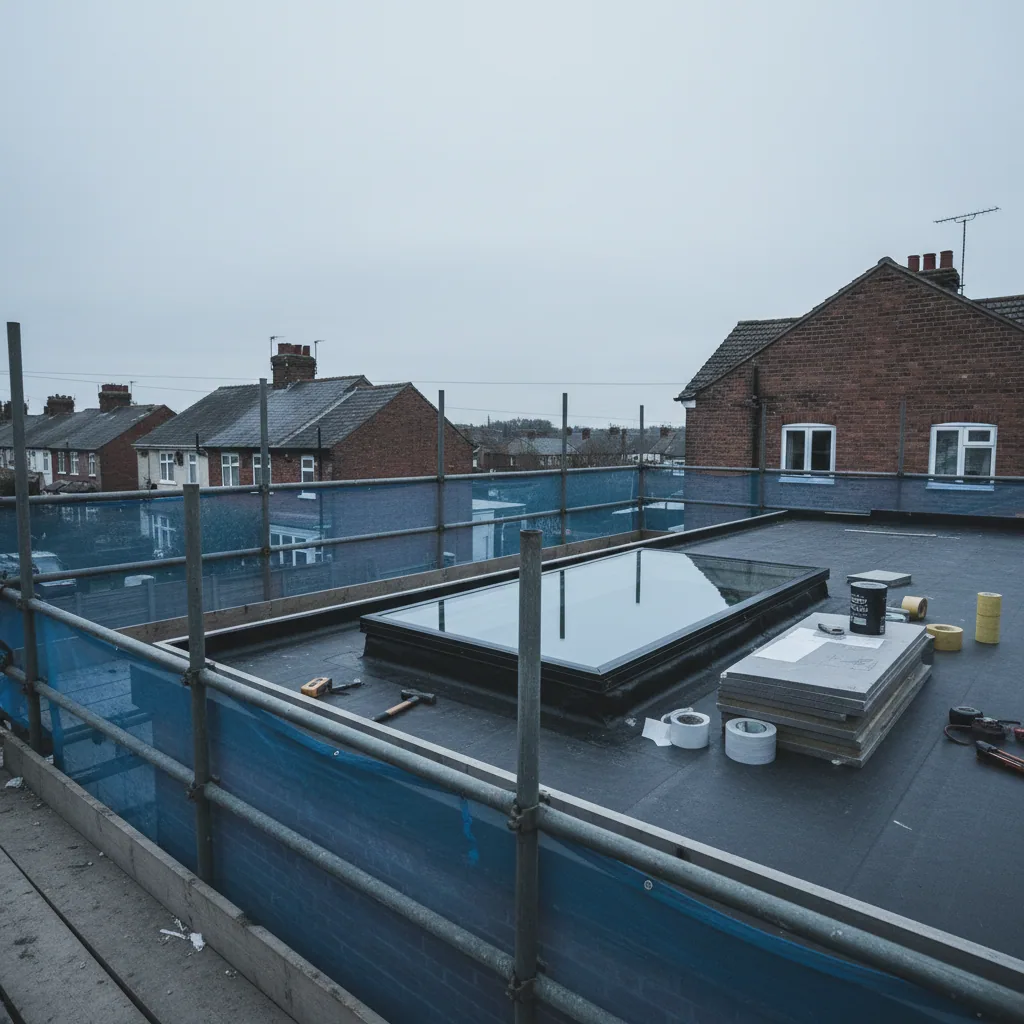
Most work here is pitched roof skylight installation on the main slope, with flat roof rooflight work on shallow back additions and rear extensions. Where a room is hard to reach we fit electric skylights with rain sensors, which matters more than usual on a frontage where the weather changes fast. Thermal specification is covered under energy efficient skylight installation.
Every skylight installation Dovercourt job gets a roof survey, one fixed written price, and a 10-year workmanship guarantee. Our installers have 25 years in the trade and work to current Building Regulations. We cover Harwich just up the road, and inland along the estuary at Mistley and Manningtree, where the exposure grade is genuinely different and we spec accordingly. Full list on areas we cover.
Request a fixed quote. A photograph of the roof from the garden and, if you can get one, a close view of an existing rooflight’s fixings tells us a great deal before we arrive.
My rooflight in Dovercourt is not leaking but there is white staining round the screws. Is that urgent?
It is worth acting on, calmly. White bloom at fixing points means the coating has failed and corrosion has started at the fixing. It rarely leaks at that stage, which is why people leave it. What follows is loss of section in the fixing shank, then movement in the frame under wind load, then water. You have time to plan a replacement properly rather than react to a ceiling stain in November, but it is not something that stabilises on its own.
Is 316L stainless really necessary this close to the sea, or is A2 enough?
On a Dovercourt frontage, A2 is not enough. Chloride attacks the passive film on A2 and causes deep local pitting rather than surface rust, so the fixing loses strength while still looking serviceable. 316L contains molybdenum and resists that mechanism far better. We fit it as standard on every coastal job. The cost difference across a single installation is small. The difference in how long the installation lasts is not.
Can you fit a rooflight on a Dovercourt terrace when there is no side access?
Usually yes, but the access plan is part of the job rather than an afterthought. Terraces here often need scaffold positioned with a neighbour’s agreement, or a tower off the rear, and that has to be settled before a unit is ordered. We work it out at survey and the price we give you includes it. What we will not do is quote a figure that assumes access we have not seen.
We are a few streets back from the seafront in Dovercourt. Do the coastal rules still apply?
Yes, though less harshly than on the front row. Salt carries inland on the onshore wind, so a house set back from the promenade still gets a real chloride dose, just not the full force the frontage takes. We treat all of Dovercourt as coastal and fit 316L stainless fixings and marine coatings throughout, because the cost difference across one installation is small and a failed fixing on any coastal roof is expensive to put right. The frontage simply reaches that point faster than the streets behind it.
What can you tell from our existing rooflight before you quote?
A great deal. White bloom around the fixings, a staining track down the covering below the unit, or a frame that feels less rigid in the wind all show corrosion that has begun even without a leak. An old rooflight on this frontage is effectively a test of what an inland specification does here, and it tells us how hard to specify the replacement. A close photograph of an existing unit’s fixings, along with a shot of the roof from the garden, tells us more before we arrive than almost anything else you can send.
Our current rooflight looks fine. Will it still fail here?
If it was fitted to an inland specification on this frontage, in time yes. The failure is inside the metal: chloride sets up deep local pitting in standard A2 fixings and lifts general coatings from the edges, and both progress while the unit still looks serviceable from the ground. Looking fine is not the same as being sound near open water. That is why we specify 316L fixings and marine coatings on every coastal job, and why an old unit’s condition is one of the first things we read at survey.
Do you match the existing slate or tile on a Dovercourt roof?
Yes. We do not change your covering to suit ourselves; we flash the new unit into what is there. On the Victorian seafront terraces that is usually natural slate, weathered with hand-dressed lead soakers, and the disturbed slates around the opening are secured with hooks where their nail holes are lost. Where a roof is tile instead, we match the profile with the correct flashing kit. Old slate is brittle and breaks when handled, so we allow for replacements at survey and match them as closely as current stock permits.
Thinking about this job? We survey across Ipswich, Suffolk and north Essex and give you a fixed price before any work starts, with a 10-year workmanship guarantee.