Skylight Installation in Aldeburgh
- Fixed quote before we start
- Roof never left open overnight
- 10-year workmanship guarantee

- Fixed quote before we start
- 10 years workmanship guarantee
- 25 years fitting rooflights
- Skylights only, not a general roofer
Aldeburgh is 20.4 miles from Ipswich in a straight line, and about forty-five to fifty minutes on the road through Snape. It is worth the drive, because the roofs here get treated to something most of Suffolk never sees: genuinely severe, unfiltered salt loading off the open North Sea, with nothing between the shingle and the front elevations but a bank of stones.
That changes what we are willing to put on a roof. A rooflight specified for the middle of the county will function in Aldeburgh. It will simply do so for a fraction of the time, and it will fail from the outside in, starting at the parts nobody looks at.
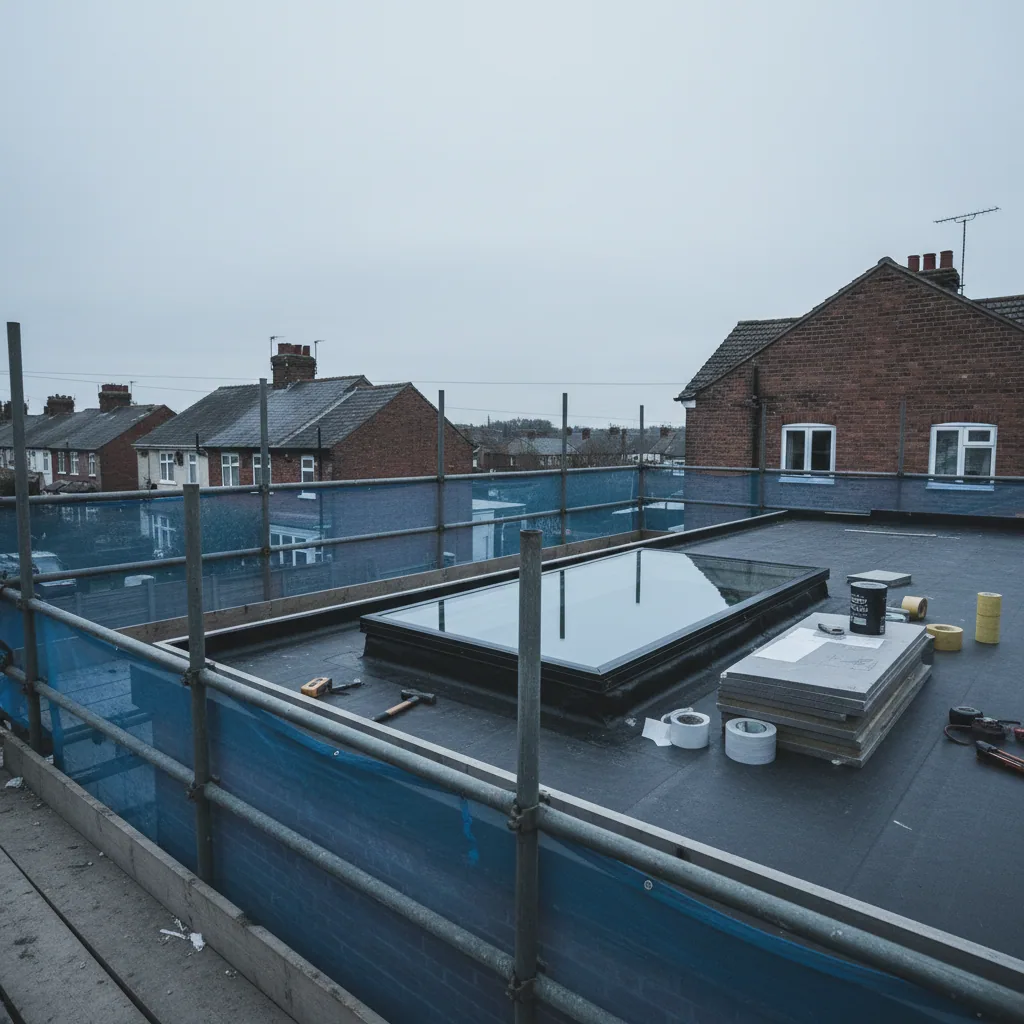
What severe salt actually does to a standard unit
Airborne chloride is not weather in the ordinary sense. It arrives as fine droplets carried on the wind, deposits on every surface, and then sits there. Rain rinses some of it away. Under a flashing lap, at a fixing head, along the edge of a sealed unit, nothing rinses. The chloride concentrates instead. The sequence that follows is predictable.
- A2 stainless fixings pit. A2, or 304, is the standard grade supplied with most flashing kits. In chloride it suffers pitting corrosion, which does not look like general rust. It bores deep at the point of attack, and the fixing loses section strength long before the head looks bad.
- Powder coat chalks, then lifts. Standard architectural polyester on an aluminium frame goes dull and powdery under salt and UV together. Once chalked, water gets under the coating at a cut edge and it lifts in flakes.
- White bloom appears at fixing points. That white crusting around a screw head is aluminium corroding, usually because a dissimilar metal fixing has set up a galvanic cell in a permanently damp, salt-rich joint.
- Sealed units fail early. The edge seal is a chemical barrier and chloride attacks it. Once it goes, argon escapes, moisture enters, and the unit mists internally. Manufacturer literature is written for average conditions. Aldeburgh is not average conditions.
The whole assembly, or none of it
This is the argument worth making before anyone chooses a product. A rooflight is not one thing. It is a frame, a coating, a sealed unit with an edge seal, a flashing set, an upstand or kerb, and forty-odd fixings. Corrosion finds the weakest of those and works there.
Specify a marine-coated frame and then fix it down with the A2 screws in the box, and the screws set the life of the job. Get the fixings right and accept a standard polyester coating, and the coating sets it. There is no point paying for one grade of protection at one layer and leaving the next at trade standard.
What “coastal specification” means on our quotes: marine-grade 316L stainless fixings throughout, including the ones you cannot see once the tiles go back. Marine-specification powder coating on any aluminium. Flashing laps set deeper than the inland minimum, because driven rain here arrives horizontally and pressure-drives water uphill. Sealed units with an edge seal rated for the exposure.
316L is the molybdenum-bearing grade, and that addition is what resists chloride pitting. It is the standard on marine hardware, so we do not treat it as an upgrade here. It is the correct part.
Seafront elevation and sheltered elevation are two different jobs
This distinction saves people money, and it is the reason we survey rather than quote from a postcode. The seaward slope takes direct salt spray and the full force of driven rain. The landward slope, sheltered by the building itself, sees a fraction of that. A rear-facing rooflight over a kitchen at the back of a seafront property does not always need the same specification as the one on the front pitch, and pretending otherwise is just selling. What it does need is an honest look at prevailing wind, building height, and whether anything upwind actually provides shelter. Often nothing does.
Conservation area consent and conservation-style units
Much of Aldeburgh sits within a conservation area, and the town carries a high density of listed buildings. Both change the rules for skylight installation in Aldeburgh in ways that are worth knowing before you plan a loft room.
Permitted development normally allows a rooflight projecting no more than 150mm above the roof plane, below the ridge line. In a conservation area, and particularly on a principal elevation visible from the street or the seafront, that permission is often restricted or removed. Listed building consent is a separate requirement from planning permission, and it applies to the fabric of the building itself.
Where consent is needed, a conservation-style unit usually answers the design objection. These sit flush or near-flush with the covering, use a slim frame with a central glazing bar to read like a traditional cast-iron light, and come in a dark finish rather than white. They are available as modern thermally broken units, so you are not trading performance for appearance. We fit them as pitched roof rooflight installations and, where a flat roof is involved at the rear, as flat roof rooflights on a purpose-built kerb.
We do not submit applications for you, but we will say at survey what we think the council will want to see and specify accordingly. For larger openings over rear extensions a roof lantern can work, though frame finish and profile need attention here more than anywhere. Part L still applies, so see energy efficient skylight installation for the U-values.
Aldeburgh stock, from the High Street to the shingle
Aldeburgh’s building stock is high value and old, and it sits in two rough bands. Along the front there are the seafront terraces and villas, tall and steeply roofed, taking the salt off the shingle with only a bank of stones in front of them. Behind, up the High Street and the lanes off it, are older cottages, some of them former fishermen’s houses, timber-framed and colourwashed or brick and pantiled, and a good deal of listed fabric among them. Towards Slaughden the ground narrows between the sea and the river Alde, about as exposed a position as any on the Suffolk coast. The Moot Hall and the conservation designation over the town centre are a reminder that most of these roofs are visible, valued and controlled, which shapes what can go on them as much as the weather does.
That combination, severe exposure and tight conservation, is exactly why the whole-assembly argument on this page matters here more than almost anywhere. A conservation officer wants a low, slim, dark unit that reads like a traditional roof light. The sea wants an assembly with every component matched to the exposure. Both have to be satisfied at once, and the way to do it is in the specification of the parts rather than by compromising on either.
Inspection, and knowing where a coastal unit is in its life
On a seafront Aldeburgh roof the value of the building makes it worth knowing where an existing unit sits in its life rather than waiting for a leak. Because corrosion works from the outside in, at the fixings and the coating and the flashing laps, the early stages are all visible from the roof before anything reaches the glass or the ceiling. Brown weeping at the fixing heads. A coating gone matt and chalky. Lifting at the corners. White bloom at the fixing points. Any of those means the assembly is working down its sequence, and on a high-value listed property that is worth catching while a replacement can be planned and consented calmly rather than forced by water coming through a decorated ceiling. We will say honestly at survey where a unit sits, including when it has years left in it.
The point that ties back to the whole-assembly argument is that the weakest visible sign usually reveals the weakest component, and on this coast the weakest component sets the life of the job. A frame in good order above corroded A2 fixings is not a sound unit. It is a unit whose fixings are about to end it.
The conservation position and the exposure also decide how a replacement is planned on a listed Aldeburgh roof. Because listed building consent covers the fabric and is separate from planning permission, the specification and the appearance of the unit are agreed with the authority before anything is ordered, which takes time. On a high-value seafront property that is a good reason to plan a replacement from the first signs of corrosion rather than waiting for a leak, because a forced replacement in midwinter leaves no room for the consent process and tempts people into a patch that this coast will undo in a season. So on the older stock we tend to survey, specify and agree the unit calmly, then fit it in a settled spell of weather. The result is a rooflight that satisfies the conservation officer on appearance and the sea on durability, fitted without the pressure that produces compromises on either.
Working in Aldeburgh
Every job is surveyed on the roof and priced once, in writing, with a fixed quote that does not move unless the specification changes. Installers with 25 years in the trade, a 10-year workmanship guarantee, installed to current Building Regulations. We replace failed units rather than patch them, because on this coast a patch buys one winter.
We cover the same stretch at Thorpeness and Leiston, and inland at Snape. The full list is on areas we cover.
Request a fixed quote for a rooflight in Aldeburgh. Tell us which way the roof slope faces and we can be useful on the phone before we come out.
Is a coastal specification actually necessary, or is it an upsell?
On a seafront elevation it is necessary. Chloride pitting on A2 stainless is a documented failure mode, and it attacks fixings buried under the tiles where you will not see the problem until something moves. The cost difference between A2 and 316L on a single rooflight is small. The cost of taking the covering off again is not.
Our house is in the Aldeburgh conservation area. Can we still have a rooflight?
Usually yes, but the type and position matter and you may need consent rather than relying on permitted development. Conservation officers care about what is visible from public view, so a rear slope is easier than a front one. A flush-fitting conservation-style unit with a slim dark frame is the usual answer. If the building is listed, listed building consent applies separately and covers the fabric.
Do the front and back roof slopes need the same specification?
Not always. The seaward slope takes direct salt spray and driven rain, while a slope in the lee of the ridge is sheltered by the building itself. We look at orientation, building height and whatever sits upwind. On a genuinely exposed plot there is often no shelter on any elevation, in which case we specify the same throughout.
Do you repair or reseal a misted rooflight?
No. Once a sealed unit has failed at the edge seal, the barrier is gone and no external sealant restores it. We replace, and correct the fixings, flashing laps and upstand at the same time.
How often should a seafront rooflight in Aldeburgh be checked?
A look at the frame and fixings once a year is sensible on a fully exposed elevation here, because corrosion works from the outside in and shows at the fixings and coating long before water reaches the glass or the ceiling. Brown weeping at the screw heads, a chalky coating, lifting at the corners or white bloom are all early stages. Catching them lets a replacement be planned and, on a listed building, consented without pressure, rather than being forced by a leak through a valuable ceiling in midwinter.
Thinking about this job? We survey across Ipswich, Suffolk and north Essex and give you a fixed price before any work starts, with a 10-year workmanship guarantee.